Why What's Not in Your Nicotine Pouch Matters as Much as What Is
Key Conclusion: QOLA's clean label promise is built on a deliberate exclusion list — 16 specific additives that commonly appear in nicotine and consumer products but have no place in a genuinely tobacco-free, wellness-oriented experience. By committing to ingredient transparency and formulation integrity, QOLA redefines what a modern nicotine alternative looks like from the inside out, giving health-conscious adult consumers a smarter, cleaner choice they can actually trust.
The conversation around clean labeling has matured well beyond food aisles. As more adults reassess their nicotine habits — driven not just by health concerns but by a broader shift toward conscious consumption — the question of what goes into a nicotine product has become impossible to ignore. When we developed QOLA's formulation philosophy, the starting point wasn't just what to include; it was an equally rigorous process of deciding what would never make the cut. That decision, repeated across 16 specific additive categories, is what we now call our clean label promise.
The Clean Label Movement Reaches Nicotine Alternatives
Clean labeling is a consumer-driven formulation philosophy in which a brand commits to removing artificial, synthetic, or unnecessary additives from its products — replacing complexity with transparency and simplicity. What began as a trend in food and beverage has steadily moved into personal wellness, supplements, and now, the emerging category of smoke-free nicotine alternatives.
The shift is significant. For decades, tobacco products operated with almost zero ingredient transparency. Traditional cigarettes contain thousands of compounds — many introduced through the curing and manufacturing process — and consumers had little recourse for understanding what they were inhaling. Even early nicotine replacement therapies such as patches and gums introduced chemical binders, artificial sweeteners, and stabilizers without meaningful disclosure.
The modern nicotine pouch category emerged partly as a corrective. Positioned as a tobacco-free, smoke-free, vapor-free alternative, the best nicotine pouches are engineered to deliver a satisfying nicotine experience without the combustion by-products and tobacco-specific compounds that make traditional products so problematic. But "tobacco-free" is not automatically synonymous with "clean." A product can be free of tobacco leaf while still containing an array of synthetic flavorings, chemical humectants, artificial sweeteners, and processing aids that health-conscious consumers would reasonably want to avoid.
According to research covered by Food Navigator's clean label industry analysis, consumer demand for transparency in ingredient lists has accelerated substantially, with a growing proportion of buyers now actively reading labels and rejecting products with unfamiliar or unnecessary components. This behavioral shift applies with equal force to nicotine products as it does to snack foods or protein supplements.
For brands like QOLA, the response to this landscape isn't simply marketing. It's a fundamental formulation commitment. In practice, that means every ingredient we consider goes through a dual filter: does it serve a genuine functional purpose, and does it meet the standard of what an informed, health-aware consumer would be comfortable with? If the answer to either question is no, the ingredient doesn't make it into the pouch.
Decoding the 16: What QOLA Refuses to Put in Your Pouch
QOLA's exclusion list covers 16 additive categories that frequently appear in nicotine and consumer wellness products. Understanding what these additives are — and why each one was specifically ruled out — is the clearest way to appreciate what clean formulation actually means in practice.
Artificial Colorants
Artificial colorants are synthetic dyes added purely for visual appeal. QOLA pouches contain no added dyes because the color of a pouch communicates nothing meaningful about its quality or flavor — and synthetic dyes have been the subject of ongoing scrutiny by regulatory bodies including the U.S. Food and Drug Administration and the European Food Safety Authority regarding their safety profiles, particularly in products used frequently and over extended periods.
Artificial Preservatives
Artificial preservatives such as parabens, BHA, and BHT are chemical compounds used to extend shelf life by inhibiting microbial growth. While functional, these compounds are associated with potential hormonal disruption and cellular effects that make them incompatible with a wellness-first formulation philosophy. QOLA achieves product stability through thoughtful moisture management and packaging rather than synthetic preservatives.
Artificial Sweeteners
Artificial sweeteners including saccharin, aspartame, and acesulfame-K are frequently used in nicotine pouches to mask bitterness or enhance flavor palatability. QOLA's flavoring approach relies on naturally derived sweetness inputs rather than synthetic alternatives, avoiding the digestive disruption and metabolic signaling concerns increasingly associated with synthetic sweeteners.
Synthetic Flavorings
Synthetic flavorings are chemically engineered aromatic compounds designed to simulate natural flavors. QOLA's flavor development uses naturally sourced flavor profiles, ensuring that the mint, citrus, berry, and other signature expressions in the range are grounded in recognizable, real-world taste rather than laboratory approximations.
Chemical Humectants
Chemical humectants are hygroscopic agents that help retain moisture in the pouch matrix. While some humectants have benign profiles, others — particularly propylene glycol in high-concentration applications — have drawn consumer concern. QOLA selects moisture-management approaches that don't require synthetic chemical humectants as a crutch.
Bleaching Agents
Bleaching agents are sometimes used in pouch manufacturing to produce a bright white pouch fiber appearance. QOLA's pouch material is not subjected to chemical bleaching, keeping the fiber processing clean and free of residual bleaching compounds that could interact with the oral mucosa during use.
Plasticizers
Plasticizers are additives used to improve the flexibility and workability of materials. In pouch manufacturing, they can find their way into the fiber matrix or the fill. QOLA's production specifications exclude plasticizer compounds, particularly those with known endocrine-disrupting profiles such as certain phthalate family compounds.
Synthetic Binders and Fillers
Synthetic binders are used in many consumer product formats to hold dry ingredients together and improve processing efficiency. QOLA opts for binders that are of natural origin and established safety, refusing to use synthetic polymer-based binding agents that add no value from the user's perspective.
Tobacco-Derived Compounds
This one may seem obvious given QOLA's tobacco-free positioning, but it deserves explicit mention. Some nicotine pouches use nicotine extracted from tobacco leaf through processes that may carry residual tobacco-specific nitrosamines (TSNAs). QOLA uses pharmaceutical-grade synthetic nicotine or highly purified nicotine with verified TSNA absence, ensuring the tobacco-free label is substantively meaningful, not merely a technicality.
Mineral Oils
Mineral oils are petroleum-derived compounds occasionally used as coating agents or processing aids in consumable products. Their inclusion in a product designed for oral use — where absorption through mucosal tissue is a real pathway — is a risk profile QOLA's formulation team has consistently rejected.
Artificial pH Adjusters
Artificial pH adjusters are chemical acids or bases used to modify the pH of the pouch matrix, which in turn affects nicotine bioavailability. While pH management is legitimate and necessary, QOLA achieves this through naturally buffered ingredient systems rather than synthetic acids or bases that could irritate oral tissue with prolonged use.
Genetically Modified Organism (GMO) Inputs
Where plant-derived inputs are used in flavor or pouch fiber, QOLA's supply chain specifications exclude components derived from genetically modified organisms, aligning with the preferences of a substantial portion of health-conscious consumers who seek non-GMO formulations across all product categories.
Heavy Metal Contaminants
Heavy metal contamination is not an intentional additive but a formulation risk that must be actively managed through raw material sourcing and testing protocols. QOLA's ingredient sourcing standards include verified heavy metal testing to ensure that lead, cadmium, arsenic, and mercury levels are non-detectable or below the most stringent global safety thresholds.
Allergen-Risk Additives
Several common food-derived additives carry significant allergen risk — including certain gums, starches, and protein-based binders. QOLA's formulation excludes these high-allergen-risk inputs, making the product accessible to a broader population and reducing the risk of unexpected sensitivity reactions.
Petroleum-Derived Ingredients
Beyond mineral oils, the broader category of petroleum-derived ingredients — including certain synthetic waxes and petroleum-based solvents used in flavor carrier systems — is excluded from QOLA's formulation. This reflects both a consumer wellness rationale and an environmental one, as petroleum-derived ingredients carry a less favorable sustainability profile.
Unnecessary Excipients
The final category is perhaps the most philosophically important: unnecessary excipients. These are ingredients that serve no genuine functional purpose in the finished product but appear in formulations as processing conveniences, cost-reduction tools, or legacy inclusions from outdated manufacturing norms. QOLA's formulation standard is "if it doesn't need to be there, it isn't there" — a principle that keeps the ingredient list genuinely minimal rather than performatively so.
Evidence & Multi-Angle Comparison: Additive Transparency Approaches in Nicotine Pouches
The clean label approach is not universally adopted in the nicotine pouch category. Understanding where QOLA's commitment sits relative to other approaches helps contextualize why the 16-additive exclusion list represents meaningful differentiation rather than mere positioning language.
Across the category, formulation philosophies broadly fall into three camps: conventional formulation (where additives are included if they're within regulatory limits), partial clean label (where a few high-profile additives are removed as marketing signals without systematic review), and full clean label commitment (where every additive is interrogated against both safety and necessity criteria).
A pattern we consistently see across consumer wellness categories is that partial clean label strategies can actually undermine trust when consumers dig deeper and find that removed headline additives have been replaced with less-familiar but equally synthetic alternatives. Full clean label commitment, by contrast, requires harder formulation work but produces a more defensible and durable consumer relationship.
| Perspective / Approach | Strengths | Trade-offs | Best Fit |
|---|---|---|---|
| Conventional formulation | Lower cost, wider ingredient toolbox, easier manufacturing scale | Ingredient lists that alienate health-conscious buyers; reputational risk as transparency norms evolve | Mass-market products where price dominates purchase decisions |
| Partial clean label | Addresses the most visible consumer concerns quickly; easier to implement without reformulation overhaul | Risk of "clean washing"; sophisticated consumers often see through selective removals | Brands transitioning their positioning without full R&D investment |
| Full clean label commitment (QOLA) | Builds genuine trust; defensible against regulatory and media scrutiny; aligns with long-term consumer wellness trends | Requires rigorous supply chain management; may limit flavor development speed | Premium wellness-oriented brands with health-conscious adult consumers as the core audience |
The clean label standard is also increasingly relevant from a regulatory preparedness standpoint. Regulatory bodies globally — including the FDA, the European Medicines Agency, and Health Canada — are actively reviewing the ingredient standards applied to nicotine alternative products. Brands with cleaner formulations are better positioned to navigate evolving regulatory requirements without costly reformulations.
Research discussed by Supply Side SJ's Food Insider Journal podcast on clean label strategy notes that consumer trust is the primary long-term asset built through clean label commitments — and that trust is significantly harder to rebuild once lost than to establish from the outset.
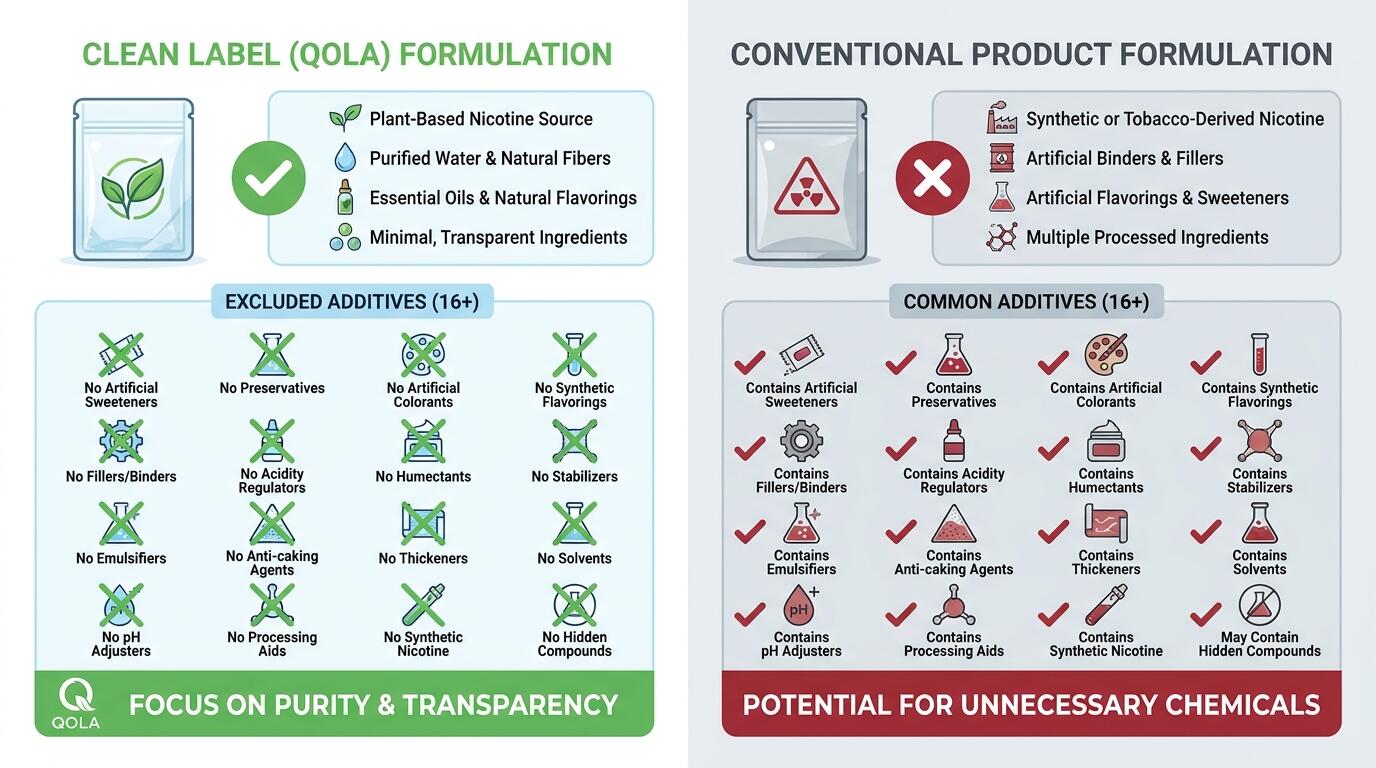
ALT: Side-by-side comparison of clean label and conventional nicotine pouch ingredient approaches highlighting QOLA's 16 excluded additives and tobacco-free formulation standards
Where This Is Heading: The Future of Ingredient Transparency in Nicotine Alternatives
Consumer demand for ingredient transparency in nicotine alternatives is not a trend that will plateau — it is a structural shift. As the demographic profile of nicotine pouch users continues to skew toward younger, health-conscious adults who have grown up reading ingredient panels and demanding accountability from consumer brands, the pressure on the entire category to adopt higher formulation standards will only intensify.
Regulatory momentum reinforces this direction. Multiple jurisdictions are developing more explicit nicotine pouch ingredient disclosure requirements, moving toward frameworks that will make full ingredient transparency not just a brand differentiator but a legal baseline. Brands that have already internalized clean formulation principles — building them into their sourcing, manufacturing, and QA protocols — will find this transition natural. Those that haven't will face disruptive reformulation timelines.
For the adult nicotine user looking to make a smarter choice today, the practical implication is straightforward: ingredient standards are a meaningful criterion for product selection, not a secondary concern. Choosing a product with a verified exclusion commitment — not just a vague "no tobacco" claim — is the clearest signal that a brand has done the deeper formulation work.
QOLA's clean label promise is designed to give health-aware consumers a concrete, specific commitment they can point to rather than a generic wellness aspiration. The 16-additive exclusion list exists because we believe the people who choose our products deserve to know exactly what they're not getting — and to trust that the answer is consistent, honest, and built into every batch.
The most actionable takeaway for a consumer navigating this category is this: ask for the exclusion list. Any brand serious about clean formulation should be able to tell you, with specificity, what they've said no to and why. If the answer is vague, that tells you something important.
Questions & Answers
Q1: How does QOLA ensure its 16-additive exclusion list is maintained across different product batches and flavors?
QOLA's clean label commitment is embedded at the supply chain level, not just the marketing level. Each raw material supplier is vetted against the exclusion criteria, and batch-level quality assurance protocols verify ingredient compliance before products reach consumers. The 16-additive exclusion list applies uniformly across all flavors and nicotine strengths in the range — from 4mg through 20mg — ensuring that choosing a different flavor doesn't mean compromising on formulation standards. Regulatory bodies such as the FDA provide foundational frameworks for ingredient safety that inform this process.
Q2: Are tobacco-free nicotine pouches automatically cleaner than traditional cigarettes or other nicotine products?
Tobacco-free status is a necessary but not sufficient condition for clean formulation. A nicotine pouch can be tobacco-leaf-free while still containing artificial sweeteners, synthetic flavorings, or chemical humectants that health-conscious consumers would want to avoid. The distinction QOLA draws is between being tobacco-free in the technical sense — no tobacco plant material — and being genuinely clean, meaning the entire ingredient set has been evaluated and unnecessary or potentially concerning additives have been removed. The European Food Safety Authority and other regulatory bodies continue to refine standards for nicotine product ingredients, making active exclusion lists more important than ever.
Q3: How long does it typically take to notice a difference when switching from conventional nicotine products to a clean-label pouch like QOLA?
The experience of switching to a clean-label nicotine pouch is qualitative rather than quantitative in the initial period. Most users notice the absence of a harsh or chemical aftertaste relatively quickly — often within the first few uses — because the cleaner flavor profile of naturally sourced ingredients sits differently on the palate than synthetic alternatives. QOLA pouches are designed for a use period of approximately 40 to 60 minutes per pouch, and users typically find that the clean formulation makes extended use more comfortable, with less gum sensitivity than products containing synthetic pH adjusters or artificial sweeteners.
The Bottom Line
QOLA's clean label promise is actionable, specific, and verifiable — not a marketing phrase but a formulation standard built into every product in the range.
Key Takeaways:
- The 16-additive exclusion list covers artificial colorants, preservatives, sweeteners, synthetic flavorings, chemical humectants, bleaching agents, plasticizers, synthetic binders, tobacco-derived compounds, mineral oils, artificial pH adjusters, GMO inputs, heavy metal contaminants, allergen-risk additives, petroleum-derived ingredients, and unnecessary excipients.
- Tobacco-free does not automatically mean clean — the full ingredient set matters, and informed consumers should demand specific exclusion commitments rather than accepting generic wellness claims.
- QOLA's approach applies uniformly across all flavors and nicotine strengths in the range, from 4mg to 20mg, ensuring consistency regardless of which variant a consumer chooses.
- Regulatory and consumer trends both point toward mandatory ingredient transparency in nicotine alternatives — brands with established clean formulation standards are better positioned for this future.
- The clearest way to evaluate any nicotine alternative's formulation integrity is to ask what it has specifically excluded, not just what it claims to contain.
If you've been looking for a nicotine alternative that takes formulation as seriously as you take your health, the next step is to explore what a genuinely clean pouch experience feels like in practice.
Explore the full QOLA range — across flavors, strengths, and formats — at the QOLA website, and find the clean-label nicotine experience designed for the way you actually live.
References & Further Reading
- Clean label 4.0: How brands are delivering on evolving consumer demands for natural products.
https://www.foodnavigator.com/Events/Clean-label-4.0-How-brands-are-delivering-on-evolving-consumer-demands-for-natural-products/ - qola.com. "QOLA Nicotine Pouches UK|No Smoking, No Vaping - Just qola".
https://qola.com/uk - Food Insider Journal Examines Clean Label Strategy and Formulation.
https://www.supplysidesj.com/labeling/healthy-insider-podcast-45-food-insider-journal-examines-clean-label-strategy-formulation - The food industry doesn't want you to read this — ingredient transparency discussion.
https://www.instagram.com/p/DXb8RNOjrXo/ - Herbal Isolates. "The Rise of Clean Label: What It Means for Flavor Ingredients".
https://herbalisolates.com/the-rise-of-clean-label-what-it-means-for-flavor-ingredients/
Note: Standards and regulatory guidance may be updated; please check the latest official documents or consult professional advisors for current requirements.
Comments
There are no comments yet.