

What "Pharmaceutical-Grade Nicotine" Actually Means — and Why It Changes Everything
Pharmaceutical-grade nicotine is nicotine purified to the highest standards used in medical and consumer health applications, free from the residual tobacco compounds, heavy metals, and combustion byproducts found in conventional tobacco products. At QOLA, this standard is not a marketing phrase — it is the technical foundation on which every pouch is built.
The shift in how adult nicotine users think about their choices has been building steadily. A growing number of people are moving away from cigarettes and even from vaping, not because they want to give up nicotine, but because they want a cleaner relationship with it. What drives that shift is increasingly a question of what goes into the product — and how rigorously it was made. This article takes you behind the science: how pharmaceutical-grade nicotine is sourced, refined, and carefully formulated into the discreet, odor-free experience that defines the QOLA nicotine pouch.
Three things make this process worth understanding. First, purity directly determines how predictably nicotine is released and absorbed. Second, the manufacturing environment shapes the safety profile of every batch. Third, the formulation decisions — flavor, filler, moisture level — are where lab science and lifestyle design meet. All three are live concerns in QOLA's development process, and together they explain why not all nicotine pouches are created equal.
Who This Information Is Relevant For
This article is written for adult nicotine users who are actively curious about what distinguishes a well-made nicotine pouch from a generic one. It is especially relevant if you fall into one of the following situations.
Applicable Scenarios:
- You are transitioning from cigarettes or a vaping device and want to understand what a cleaner nicotine source looks like in practice
- You are already using nicotine pouches and want to make a more informed, quality-driven brand choice
- You are a health-conscious urban professional who reads ingredient panels and cares about production standards, not just convenience
Not Applicable/Cautions:
- This article does not constitute medical advice and should not replace a conversation with a healthcare provider about nicotine use
- Nicotine pouches, regardless of their quality tier, are intended exclusively for adult users and are not appropriate for anyone who is pregnant, under the legal age in their jurisdiction, or sensitive to nicotine
The Problem With "Nicotine" as a Generic Ingredient
Not all nicotine is equivalent — and understanding why requires a brief look at where nicotine comes from and what refinement actually removes.
Nicotine in its raw extracted form comes from the tobacco plant, Nicotiana tabacum. Crude extraction yields a compound that is chemically nicotine, but it carries with it a range of co-extractants: tobacco-specific nitrosamines (TSNAs), trace alkaloids, particulate matter, and residual solvents depending on the extraction method. For decades, this quality of nicotine was entirely acceptable in conventional tobacco products because the tobacco leaf itself contributed so many other compounds that isolating nicotine purity was essentially irrelevant.
The modern nicotine alternative market changed that calculus entirely. When you remove tobacco from the product — which is precisely what a tobacco-free nicotine pouch does — the purity of the nicotine itself becomes the dominant quality variable. There is no tobacco matrix to obscure impurities. There is no combustion that transforms the chemical profile. What you put in is, in a very direct sense, what the user experiences.
Pharmaceutical-grade refinement addresses this by subjecting extracted nicotine to multiple purification passes — typically involving distillation and filtration steps — until co-extractants are reduced to levels that meet stringent quality specifications. The resulting nicotine is a highly stable, clearly characterized compound that behaves predictably in a formulation. For QOLA's formulation team, this predictability is essential: it means nicotine release can be tuned by adjusting other formulation parameters rather than compensating for variability in the active ingredient itself.
It is worth noting that "pharmaceutical-grade" refers to a production and purity standard, not to a drug classification. Nicotine pouches are consumer products. But adopting the purity benchmark that the pharmaceutical industry applies to nicotine-containing therapies is a deliberate signal about where QOLA sits on the quality spectrum.
From Raw Material to Ready-to-Use Pouch: The Core Formulation Process
Sourcing, Verification, and Incoming Quality Control
Step 1: Selecting and Verifying the Nicotine Source
Before a gram of nicotine enters the QOLA production environment, it goes through incoming quality control — a stage that in practice determines everything that follows. Pharmaceutical-grade nicotine arrives with a certificate of analysis (CoA) from the supplier, documenting purity level, residual solvent content, TSNA levels, and pH. QOLA's quality team does not simply accept the supplier's data; independent verification using chromatographic methods (such as high-performance liquid chromatography, or HPLC) confirms that the material meets internal specification before it is released for use.
This step typically involves holding the raw material in quarantine until testing is complete — a standard practice borrowed directly from pharmaceutical manufacturing. In our experience developing nuanced formulations, incoming material variability is one of the most common sources of batch-to-batch inconsistency in the broader nicotine product category. Building a hard gate at this stage eliminates that variable before it can propagate.
Step 2: Building the Pouch Matrix — Filler, Moisture, and pH Engineering
The pouch itself is a carefully engineered delivery system. The filler — typically a blend of plant-based fibers and food-grade bulking agents — is selected for its moisture-retention properties, texture consistency, and chemical neutrality relative to nicotine. Moisture content is critical: too dry, and the pouch releases nicotine too slowly; too wet, and the experience becomes uncomfortable and the shelf life shortens. QOLA's formulation targets a moisture equilibrium that supports the characteristic experience window a user can expect from each pouch.
pH is equally important and often underappreciated. Nicotine exists in two forms depending on the acidity of its environment: the protonated (salt) form and the free-base form. The free-base form is more readily absorbed through mucosal tissue, which means that pH directly controls how quickly and efficiently nicotine is released from the pouch. QOLA's formulation team manages pH through careful selection of buffering agents, ensuring that each strength tier — from the gentler 4 mg option to the more experienced-user 20 mg option — delivers its nicotine in a controlled, consistent arc rather than an abrupt spike.
Step 3: Flavor Integration and Final Assembly
Flavor development at QOLA is not an afterthought applied over a base product. Flavor compounds are evaluated alongside the nicotine formulation from early in the development cycle, because certain flavor chemistries interact with nicotine stability or pouch pH. Food-grade flavoring systems that pass stability testing at the target moisture and temperature conditions are selected, with sensory evaluation panels confirming that the intended flavor profile holds across the product's shelf life.
Final assembly — filling the nonwoven fiber pouch to target weight, sealing, and packaging — takes place in a controlled environment. The finished product goes through release testing before it reaches the consumer, confirming that nicotine content per pouch matches the declared strength level on the label.
Nicotine Strength Tiers: What the Range Actually Signals
A common question among new pouch users is what the milligram number on the can actually means in practice. QOLA offers a range spanning from 4 mg to 20 mg per pouch, and understanding why that range exists is part of understanding the lab philosophy.
| Dimension | Entry Level (4 mg) | Mid Strength | High Strength (20 mg) |
|---|---|---|---|
| Target user | Light nicotine users, first-time pouch switchers | Moderate smokers / vapers transitioning | Heavy smokers, experienced nicotine users |
| Nicotine release profile | Gentle, gradual onset | Balanced onset and duration | Fuller, sustained delivery |
| Recommended use case | Daytime use, social settings, low-dependency tapering | General replacement of cigarette habit | High-dependency replacement |
| Formulation complexity | Simpler pH buffering | Moderate buffering adjustment | Precise free-base management |
This tiered structure reflects a deliberate design logic: the lab does not simply add more nicotine to a base formula. Each strength tier requires recalibration of the pH system, the moisture profile, and in some cases the filler blend, because a higher nicotine load changes the chemical dynamics of the pouch matrix.
What "Tobacco-Free" Changes at the Production Level
The tobacco-free designation is not simply about removing a leaf from the formula — it restructures the entire production safety profile. In a conventional smokeless tobacco product, tobacco leaf contributes fermentation-derived nitrosamines that are essentially unavoidable. A tobacco-free production line, by contrast, never introduces the tobacco matrix, so TSNAs must be controlled at the nicotine source rather than managed around a plant matrix.
This means QOLA's production environment functions more like a nutraceutical or pharmaceutical fill-and-finish facility than a traditional tobacco manufacturing site. Cleanroom principles — controlled air quality, personnel hygiene protocols, equipment sanitization standards — apply because the product has no inherent antimicrobial or stabilizing tobacco chemistry to fall back on. The result is a product that is demonstrably cleaner at the production level, not just at the ingredient level.
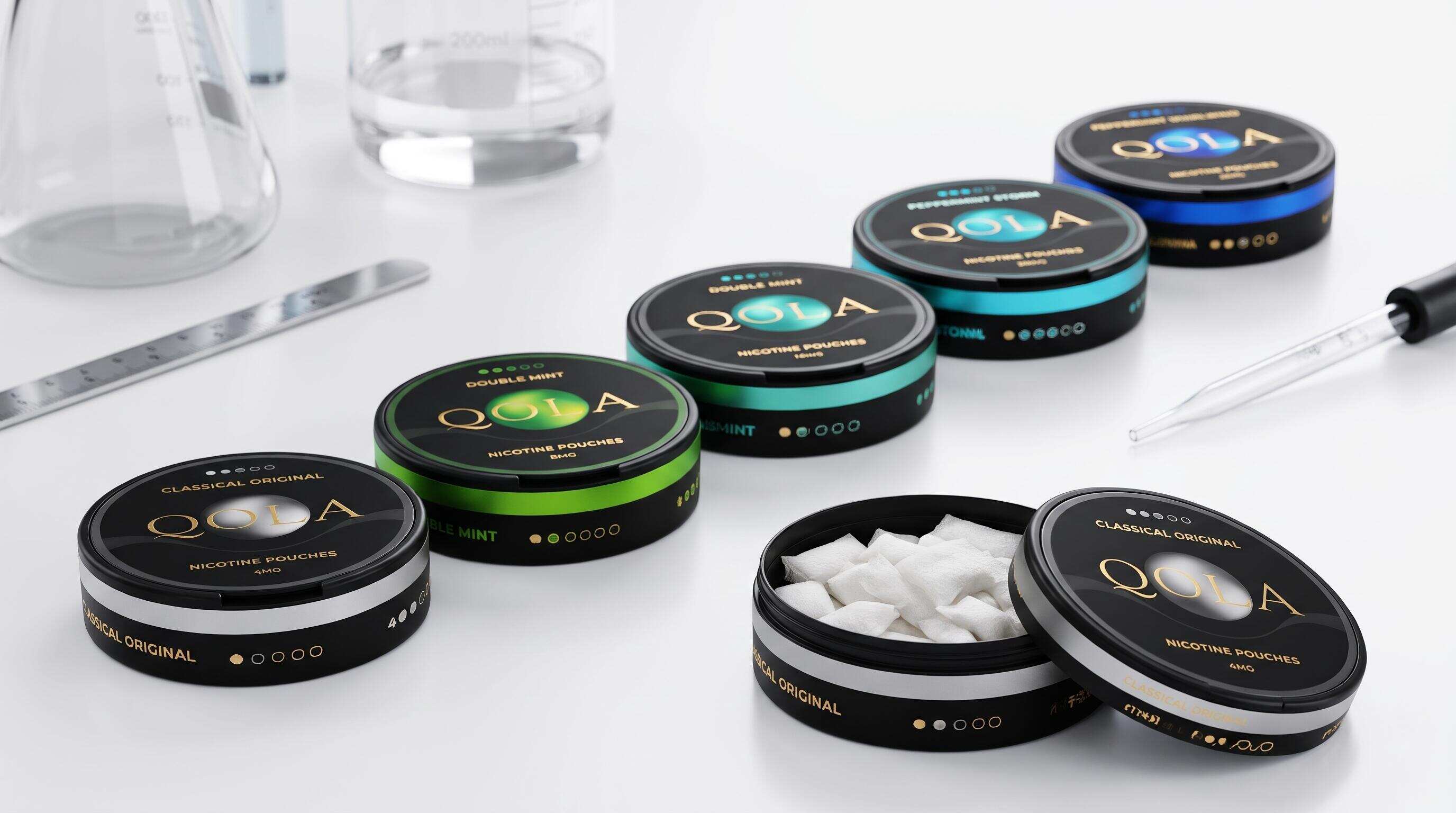
ALT: QOLA tobacco-free nicotine pouches arranged by strength level on a lab surface, showing the full 4mg to 20mg pharmaceutical-grade product range
Advanced Considerations: Stability, Shelf Life, and What Can Go Wrong
Stability testing is one of the less glamorous but most consequential parts of bringing a nicotine pouch to market. Nicotine is a relatively stable compound under controlled conditions, but it oxidizes in the presence of air and light, and its bioavailability shifts when moisture content drifts outside target ranges. QOLA's stability program subjects finished products to accelerated aging conditions — elevated temperature and humidity — to predict real-world shelf performance and confirm that the declared nicotine content and sensory profile hold through the product's useful life.
A common misconception is that a higher milligram rating automatically means a harsher experience. In practice, the experience of a well-formulated 20 mg pouch can be smoother than a poorly formulated 10 mg pouch if the pH system and moisture balance are better controlled in the former. Purity and formulation discipline matter more than the number on the label.
Another point worth clarifying: pharmaceutical-grade nicotine is distinct from synthetic nicotine. Pharmaceutical-grade is a purity and process standard applied to plant-derived nicotine; synthetic nicotine is produced via chemical synthesis without a tobacco plant source. Both can be used in nicotine pouches, and both have distinct regulatory and commercial considerations. QOLA's pharmaceutical-grade positioning refers specifically to the purity standard applied to its nicotine source material and the rigor of its manufacturing process.
Frequently Asked Questions
Q1: How does pharmaceutical-grade nicotine differ from the nicotine in standard tobacco products?
Pharmaceutical-grade nicotine undergoes multiple purification stages to remove tobacco-specific nitrosamines, residual solvents, and co-extracted alkaloids that are present in lower-purity nicotine used in conventional tobacco products. The result is a chemically cleaner compound with a more predictable, consistent purity profile. Because QOLA pouches contain no tobacco leaf, this purity standard directly determines the user's exposure profile — there is no tobacco matrix to dilute or obscure what is actually in the product.
Q2: Are higher-strength QOLA pouches simply the same formula with more nicotine added?
No — each strength tier in the QOLA range involves distinct formulation adjustments, not just a change in nicotine quantity. Higher nicotine loads alter the pH dynamics and moisture behavior of the pouch matrix, so the buffering system, filler composition, and moisture targets are recalibrated at each strength level. This is what makes a well-made high-strength pouch deliver a controlled, sustained nicotine release rather than an uncomfortable initial spike.
Q3: How long does the nicotine experience from a QOLA pouch typically last, and what affects it?
QOLA pouches are designed to deliver a lasting nicotine experience — the brand's range is formulated to provide a consistent, long-lasting release that supports the user through meaningful intervals, as reflected in the brand's noted 40–60 minute usage window. Duration is influenced by individual factors including salivary pH, placement of the pouch in the mouth, and whether the user is a first-time or experienced user. Strength level and formulation tier also play a role, with higher-strength options generally offering a fuller and more sustained delivery arc.
Final Thoughts
The science behind a nicotine pouch is easy to overlook when you are holding something that fits discreetly under your lip and delivers a clean, flavorful experience. But the lab decisions — the purity standard of the nicotine, the pH calibration, the moisture engineering, the stability testing — are what separate a product that genuinely works from one that simply claims to.
Key Takeaways:
- Pharmaceutical-grade purity is a production standard, not a marketing phrase: it means the nicotine in every QOLA pouch has been verified to remove the impurities inherent in lower-grade nicotine materials.
- Formulation is holistic: strength, pH, moisture, and flavor are all engineered together — changing one variable requires recalibrating the others.
- Tobacco-free production demands cleaner manufacturing environments, because the natural tobacco matrix that stabilizes conventional products is entirely absent.
- The 4 mg to 20 mg range is not a simple linear scale — each tier is a distinct formulation designed around the needs of a specific user profile.
- Stability and shelf-life testing ensure that what is on the label matches what the user actually experiences, batch after batch.
Understanding what goes into a QOLA pouch is ultimately about trust — knowing that the clean, discreet experience you get today will be the same one you get next month. That consistency starts in the lab, long before the can reaches your hand.
Ready to experience nicotine on its own terms? Explore the full range of tobacco-free, pharmaceutical-grade nicotine pouches at QOLA — available in multiple flavors and strengths designed to meet you wherever you are in your nicotine journey.
Sources & Citations
- qola.com. "QOLA Nicotine Pouches UK|No Smoking, No Vaping - Just qola".
https://qola.com/uk - U.S. Food and Drug Administration. "Nicotine: The Addictive Component of Tobacco Products — Regulatory Guidance and Standards".
https://www.fda.gov - World Health Organization. "Tobacco Control and Nicotine Alternative Products — Global Standards and Evidence Review".
https://www.who.int
Note: Standards and regulatory guidance may be updated; always consult the latest official documents or a qualified professional advisor for current requirements.
Comments
There are no comments yet.