

Is a High-Strength Nicotine Pouch Right for You? A Quick Checklist for 16mg–20mg Users
High-strength nicotine pouches — defined here as products delivering between 16mg and 20mg of nicotine per pouch — are not designed for everyone, but for the right person, they can be a genuinely transformative tool for moving away from heavy tobacco use. As more adult consumers explore tobacco-free nicotine alternatives, one of the most common questions we encounter is simply: "Am I actually the kind of person who needs this strength?" The answer depends on more than just curiosity — it depends on your existing consumption habits, your body's familiarity with nicotine, your daily routines, and your goals.
This checklist was built from patterns we consistently see among users navigating the transition to tobacco-free nicotine products. It is intended for adults who are already nicotine-experienced and are actively considering whether a higher-potency pouch fits their lifestyle. Each item below represents a real-world signal that tends to indicate suitability — along with honest caveats about when it might not be the right fit. Work through the list, check off the indicators that apply to you, and use the guidance at the end to make an informed, confident decision.
The Checklist: Signs You May Be Ready for High-Strength Pouches
You Are a Heavy or Long-Term Cigarette Smoker
Heavy cigarette smokers — typically those who have smoked more than a pack a day for a significant period — have developed a tolerance to substantial amounts of nicotine delivered rapidly through combustion. That tolerance is a key variable when selecting pouch strength. Standard low-strength or moderate-strength pouches, which typically sit below 8mg, often feel underwhelming to this group, failing to satisfy the craving in a meaningful way and leading users to discard the pouch early or reach for a cigarette out of frustration.
A high-strength pouch in the 16mg–20mg range is designed to meet this elevated nicotine demand without smoke, ash, or the dozens of combustion byproducts associated with cigarettes. For this user profile, the higher concentration is not an indulgence — it is a functional necessity for the alternative to work as intended.
Best for: Adults who currently smoke or recently smoked more than half a pack daily and find lower-strength options unsatisfying.
Watch out: Even experienced smokers may need a brief adjustment period before they find the ideal usage duration per pouch — start with shorter sessions and work up.
You Have Already Tried Lower-Strength Pouches Without Adequate Satisfaction
One of the clearest signals that a strength upgrade is appropriate is a consistent pattern of dissatisfaction with lower-potency products. In our work with consumers transitioning from tobacco, this is one of the most reliable predictors of who will respond well to the 16mg–20mg tier. If you have genuinely given moderate-strength pouches a fair trial and still find yourself craving tobacco shortly after using them, the product is likely not matching your established nicotine threshold.
This is not about chasing a stronger "hit" for recreational reasons — it is about meeting physiological need in a way that actually supports a successful transition. A pouch that does not satisfy will not replace tobacco effectively. For detailed context on how to navigate strength selection from the beginning, the complete guide to nicotine pouches offers a thorough breakdown of the entire spectrum.
Best for: Experienced pouch users who have methodically worked up through lower strengths and found them consistently inadequate.
Watch out: "Inadequate satisfaction" should be distinguished from normal adjustment discomfort during the first few days of use. If you are brand-new to pouches, give a moderate strength at least a week before concluding it is insufficient.
You Are an Experienced Smokeless Tobacco User
Users of traditional smokeless tobacco products — including chewing tobacco, snuff, or snus — are accustomed to concentrated nicotine delivery from oral products. These products can deliver nicotine in quantities that make standard low-strength pouches feel noticeably weak by comparison. For this group, high-strength tobacco-free pouches represent a cleaner, odor-free alternative that respects their existing tolerance rather than asking them to radically reduce their nicotine intake overnight.
The key distinction is that tobacco-free nicotine pouches in the 16mg–20mg range deliver their effect through pharmaceutical-grade nicotine without any tobacco leaf, tobacco-specific nitrosamines, or the brown staining and odor associated with traditional smokeless products. It is a meaningful upgrade in cleanliness while preserving the satisfaction level this demographic genuinely needs.
Best for: Adults transitioning from dip, chew, snus, or other oral tobacco formats who want a tobacco-free alternative that actually competes on strength.
Watch out: Even if your former product was strong, pay attention to how your body responds in the first session — everyone absorbs nicotine from pouches slightly differently depending on saliva levels and individual metabolism.
You Need Nicotine Relief During Extended No-Smoking Periods
Modern life frequently places heavy smokers in situations where smoking is simply not possible — long flights, all-day meetings, hospital visits, indoor events, or shifts in environments with strict no-smoking policies. For this group, a moderate-strength pouch may take the edge off temporarily, but a high-strength option provides more robust and sustained relief, reducing the likelihood of breaking a no-smoking commitment out of mounting discomfort.
High-strength pouches used discreetly under the lip leave no visible evidence, produce no vapor, and generate no odor — making them practically invisible in professional or formal settings. This is one of the scenarios where the 16mg–20mg range earns its place as a practical tool rather than simply a preference.
Best for: Heavy smokers who regularly need to abstain for hours at a time and find lower-strength options insufficient for extended periods.
Watch out: High-strength pouches are not intended for chain use. Using one immediately after another elevates the risk of nicotine-related side effects including nausea, dizziness, or headache. Space usage appropriately.
You Have a High Body Mass or Fast Nicotine Metabolism
Nicotine metabolism varies meaningfully between individuals. Research in pharmacology has established that factors including body mass, genetic variation in liver enzyme activity (particularly the CYP2A6 enzyme), and habitual use all influence how quickly the body processes nicotine. Individuals who metabolize nicotine rapidly — sometimes called "fast metabolizers" — will clear nicotine from their system more quickly and may therefore require a higher concentration to experience sustained satisfaction from a single pouch.
This is not a reason to maximize strength arbitrarily; it is a reason to consider whether your personal biology makes higher concentrations more appropriate. If you consistently notice that the effect of a pouch fades significantly within the first fifteen minutes of use, rapid metabolism may be a contributing factor worth considering alongside your overall tolerance profile.
Best for: Adults who consistently find that the effect of moderate-strength pouches wears off unusually quickly, independent of their smoking history.
Watch out: Fast metabolism is only one variable. Do not use it as a rationalization for escalating strength without first confirming that lower options genuinely do not work for you over a fair trial period.
You Are Actively Trying to Eliminate Cigarettes Entirely and Need a Strong Anchor
Nicotine replacement approaches work best when the alternative genuinely competes with the product being replaced. For heavy smokers, the difference between a satisfying alternative and a marginal one often determines whether the transition sticks. We consistently see that users who attempt to reduce cigarette consumption using underpowered alternatives return to full smoking use within weeks, not because they lacked willpower, but because the product did not match their neurological demand for nicotine.
A 16mg–20mg tobacco-free pouch used strategically — particularly during the highest-craving moments of the day — creates a credible anchor that the brain can accept as a genuine substitute. This strength tier is not a permanent destination for most users; it is often the bridge that makes the initial weeks of transition realistic rather than grueling.
Best for: Heavy smokers in the active phase of quitting or dramatically reducing cigarette consumption who need their alternative to be unambiguously satisfying.
Watch out: If your longer-term goal is to reduce nicotine dependence overall, plan a gradual step-down in strength once cigarettes are out of your routine. High-strength pouches are most effective as a transitional tool, and understanding the safety profile of nicotine pouches across strengths is worth exploring — a detailed review of nicotine pouch safety can help you make that assessment with confidence.
You Are a Stress-Intensive Professional Who Relies Heavily on Nicotine
Certain professional contexts — high-stakes finance, emergency services, healthcare, logistics, and other high-pressure environments — have historically produced heavy nicotine users who rely on the substance for cognitive focus and stress management during intense working periods. For these individuals, nicotine is not simply a habit; it is integrated into their professional performance pattern.
For this demographic, switching to a lower-strength option during a demanding workday often feels cognitively disruptive. A high-strength tobacco-free pouch provides the nicotine load that keeps mental sharpness intact without requiring a trip outside, without leaving an odor on clothing, and without the visible social stigma of smoking. It is a genuinely discreet and functional choice for environments where discretion is not optional.
Best for: High-performance professionals who are accustomed to frequent, heavy nicotine use during demanding work sessions and need their alternative to maintain the same functional baseline.
Watch out: Relying on nicotine as a primary cognitive performance tool is a pattern worth examining over time. High-strength pouches are cleaner than smoking, but dependency management remains an important long-term consideration.
You Have Already Consulted a Healthcare Provider and Received Guidance
This checklist item stands slightly apart from the others: it is not about your body's tolerance or usage history — it is about your approach to the decision. Adults who have discussed their nicotine use with a physician or pharmacist and received guidance supporting a higher-strength alternative product are, categorically, in the best position to use it responsibly. They have an external check on their health profile, understand any contraindications related to cardiovascular health or other conditions, and have a framework for monitoring their response.
If you have not had that conversation and you have known cardiovascular concerns, a family history of heart conditions, or take medications that interact with nicotine metabolism, it is worth having it before selecting the highest strength tier.
Best for: Adults who have already sought professional guidance and received a reasonable green light to use higher-strength nicotine alternatives as part of a tobacco reduction plan.
Watch out: High-strength nicotine pouches are not suitable for individuals who are pregnant, under 21, or who have significant unmanaged cardiovascular conditions. When in doubt, the conversation with a healthcare provider is a non-negotiable first step.
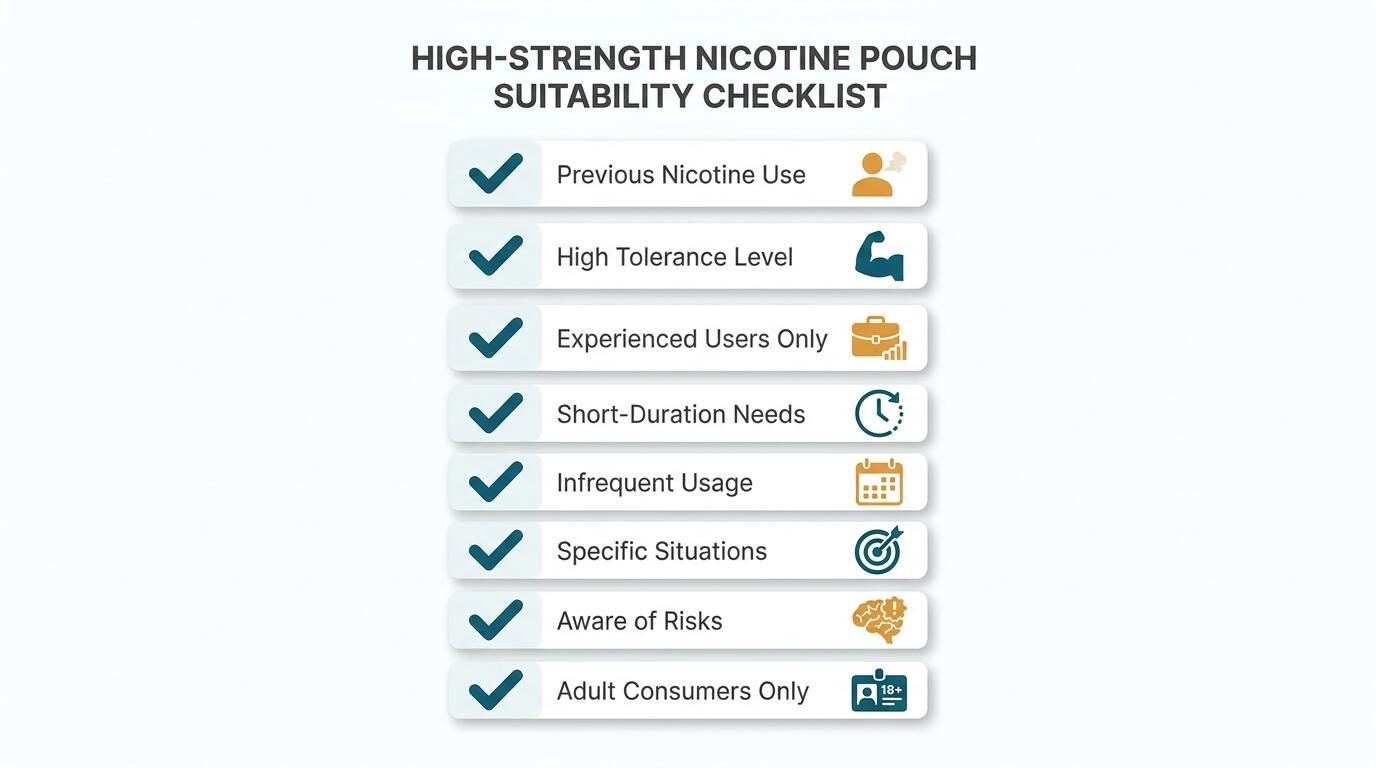
ALT: Checklist summary showing eight key indicators for adult nicotine users evaluating whether 16mg to 20mg tobacco-free nicotine pouches are appropriate for their lifestyle and tobacco use history
Quick Comparison at a Glance
| Indicator | Best For | Key Strength | Limitation |
|---|---|---|---|
| Heavy cigarette smoker | Adults smoking more than half a pack daily | Directly matches established nicotine tolerance | May still require a brief adjustment period |
| Prior low-strength pouch dissatisfaction | Experienced pouch users who've tried moderate options | Addresses genuine physiological mismatch | Should not substitute for initial product trial |
| Smokeless tobacco background | Transitioning from dip, chew, or snus | Cleaner equivalent to high-nicotine oral products | Individual absorption still varies person to person |
| Extended no-smoking periods | Heavy smokers in smoke-free environments | Provides sustained relief over long windows | Not designed for immediate back-to-back use |
| Fast nicotine metabolism | Adults who find effects fade unusually quickly | Accounts for biological variation in nicotine processing | Metabolism alone should not drive the decision |
| Active cigarette elimination effort | Smokers in the acute transition phase | Creates a credible, satisfying bridge away from cigarettes | Should ideally be part of a planned step-down strategy |
| High-pressure professional use | Demanding work environments requiring discretion | Fully discreet, odor-free, smoke-free performance support | Long-term dependency patterns still warrant monitoring |
| Healthcare provider-guided use | Adults with a clinical green light | Medically informed approach to strength selection | Not appropriate without medical clearance for high-risk individuals |
How to Choose the Right Strength for Your Situation
Selecting the right pouch strength is fundamentally a matching exercise: match your established nicotine level to a product that meets it, then assess how well the transition holds. If multiple items on this checklist apply to you — say, you are a heavy smoker who has tried lower-strength options without success and regularly needs to abstain during long workdays — the 16mg–20mg range is a logical starting point for your situation.
If only one item applies, the case is less clear-cut. A person who is simply curious about stronger options but smokes lightly or not at all should not approach high-strength pouches as an entry point. Those individuals are better served by QOLA's lower-strength offerings, which provide a gentler and more appropriately calibrated experience.
A common misconception worth addressing directly: stronger pouches are not "better" in any absolute sense. They are more appropriate for a specific user profile. The goal of a nicotine pouch is not to maximize intake — it is to satisfy your established demand in a cleaner, more discreet format. Choosing the right strength is about precision, not ambition. Many users who start in the 16mg–20mg tier gradually step down to 8mg or 12mg once they have successfully broken the cigarette habit and their baseline nicotine need naturally decreases.
If you are entirely new to nicotine pouches and want a comprehensive foundation before selecting a strength, working through a structured beginner's resource first is a smart investment of time.
People Also Ask
How do I know if I need a 16mg or 20mg nicotine pouch?
The clearest signal that a 16mg or 20mg nicotine pouch may be appropriate is a history of heavy tobacco use — typically more than a pack of cigarettes per day — combined with consistent dissatisfaction from lower-strength alternatives. High-strength pouches are designed to match the nicotine demand of established heavy users, not to serve as a starting point for new nicotine consumers. If lower-strength options have genuinely failed to satisfy your cravings after a fair trial, stepping up is a reasonable next move.
Are high-strength nicotine pouches safe for someone who already smokes heavily?
Tobacco-free nicotine pouches do not contain tobacco leaf, combustion products, or smoke, which removes many of the most harmful components associated with heavy cigarette use. For heavy smokers, switching to a tobacco-free nicotine pouch eliminates exposure to combustion-related toxicants. That said, nicotine itself is a pharmacologically active compound that affects cardiovascular and neurological systems, and adults with pre-existing health conditions should consult a healthcare provider before choosing any high-strength nicotine product. The U.S. Food and Drug Administration (FDA) provides publicly available information on nicotine product categories that is worth reviewing.
How long does a 16mg–20mg nicotine pouch typically last per session?
The effective duration of a high-strength nicotine pouch per session varies by individual metabolism, saliva production, and placement technique, so no universal figure applies to all users. Generally, tobacco-free pouches in this strength range are designed to deliver their nicotine content gradually over an extended period — many experienced users find one pouch satisfies them for a meaningful portion of their typical inter-cigarette interval. Beginning with shorter sessions and extending duration based on your personal response is the most reliable approach to calibrating use.
Key Takeaways
- High-strength nicotine pouches in the 16mg–20mg range are designed for a specific user profile: adults with established, high nicotine tolerance from heavy cigarette smoking, smokeless tobacco use, or long-term nicotine dependency — not for beginners or light users.
- Consistent dissatisfaction with lower-strength pouches is one of the most reliable signals that the 16mg–20mg tier is appropriate for your personal nicotine threshold.
- The goal of a high-strength pouch is to match — not exceed — your existing demand, creating a genuinely satisfying tobacco-free alternative that supports a sustainable transition away from cigarettes.
- Discretion, absence of smoke, and absence of odor make high-strength tobacco-free pouches a practical option for professionals and urban adults who need reliable nicotine relief in settings where smoking is impossible.
- A planned step-down approach — using high-strength pouches as a bridge and gradually reducing to lower strengths over time — reflects the most thoughtful long-term strategy for overall nicotine management.
If this checklist has helped clarify where you stand, the next step is straightforward: explore a product range that actually matches your profile with the quality and variety it deserves.
Ready to experience nicotine on your own terms? Explore QOLA's full range of tobacco-free nicotine pouches — available across diverse flavors and strengths from 4mg through 20mg — and take your first step toward a cleaner, smarter nicotine alternative designed for your modern lifestyle.
References & Further Reading
- Snuscore. "How to Find Your Perfect Nicotine Pouch Match (Flavour + Strength Guide)".
https://snuscore.com/en-jp/blogs/news/how-to-find-your-perfect-nicotine-pouch-match-flavour-strength-guide?srsltid=AYCX9vJq4t7FmFQi0L6A7xHUFvtlyZmAdjEMGeHQiykwofwIt58JNZzI - HitSnus. "Mild vs Strong Nicotine Pouches: Which Strength Is Right for You?".
https://hitsnus.com/blogs/news/mild-vs-strong-nicotine-pouches-which-strength-is-right-for-you?srsltid=AYCX9vLpKeSMSFiHXz1gYk6ZtUy1ZYZQNBsqOI4c5kNKqXweY1vdTXOK - qola.com. "QOLA Nicotine Pouches UK|No Smoking, No Vaping - Just qola".
https://qola.com/uk - Swedish Products Online. "What Strength Nicotine Pouch Should I Start With?".
https://swedishproducts.online/what-strength-nicotine-pouch-should-i-start-with/ - Google. "Nicotine Pouch Beginner Mistakes and How to Avoid Them".
https://www.google.com/goto?url=CAESvQEBxCJF18Z5ttU36lJL828VB1dPJAtq5va8sB43BB0Y8pc2TPeCFj7U992OCj-dxSNCqSwUeuEYUryFSn8Xat0yX9eaQ8LjyHofKleja8XqLlOp8dtlmzeSH0RuL97O02K0hz7U-GXxgGbW5F4SErzbLaNTlTUS3BhwpYp8AZdJaBdriPcormwVUXkt5P2mwTvAliBrSGLgalawyByz9IO34cud6PAdKqTCyWPcMHY38It9UBekIzLpd3A02jE
Note: Standards and product regulations may be updated; please check the latest official documents or consult professional advisors before making health-related decisions.
Comments
There are no comments yet.