

Understanding Nicotine Pouch Dependence: What You Actually Need to Know
Key Conclusion: Nicotine pouch dependence is a real and legitimate consideration for any adult who uses these products regularly — but it exists on a spectrum that is meaningfully different from tobacco addiction. By understanding how nicotine pouches work, what dependence actually means in practice, and how to use these products intentionally, you can make genuinely informed choices about whether nicotine pouches fit your lifestyle, your health goals, and your long-term relationship with nicotine.
The question of whether nicotine pouch dependence is something to worry about does not have a single clean answer — and that is precisely why it deserves a clear-eyed, honest exploration. If you are a current smoker thinking about switching, a professional who values discretion, or simply someone curious about tobacco-free alternatives, this guide is for you. It lays out what dependence actually means in the context of nicotine pouches, how to approach your use mindfully, and how to troubleshoot patterns that may not be serving your goals.
Before You Start: What to Know Before Reading This Guide
Nicotine dependence, in any form, is a topic that deserves intellectual honesty rather than either dismissal or alarm. Before diving into the steps and strategies below, it helps to arrive with a few foundational understandings in place.
First, it is worth clarifying what a nicotine pouch actually is. A nicotine pouch is a small, tobacco-free product placed between the gum and upper lip that delivers nicotine through the oral mucosa — without smoke, vapor, or tobacco leaf. Because nicotine pouches contain no combusted material and no tobacco, they eliminate many of the most harmful compounds associated with traditional cigarette use, while still delivering the nicotine that adult users seek. For a thorough primer, this essential introduction to nicotine pouches covers the basics in accessible detail.
Second, dependence and harm are related but distinct concepts. Nicotine itself is an addictive substance — that is a well-documented fact, confirmed by organizations including the U.S. Centers for Disease Control and Prevention and the World Health Organization. But the degree of harm associated with nicotine use depends heavily on the delivery mechanism. Smoking delivers nicotine alongside thousands of toxic combustion byproducts. Nicotine pouches do not combust anything and contain no tobacco.
Third, your personal history matters. Someone transitioning from a pack-a-day smoking habit approaches this topic differently than someone who has never used nicotine before. This guide speaks to both groups, but the right conclusions may differ based on your starting point.
Preparation checklist before reading further:
- Honest assessment of your current nicotine use pattern and history
- Basic understanding of why you are considering or already using nicotine pouches
- Openness to approaching dependence as a nuanced topic rather than a binary one
- Willingness to track your own usage and notice how it evolves over time
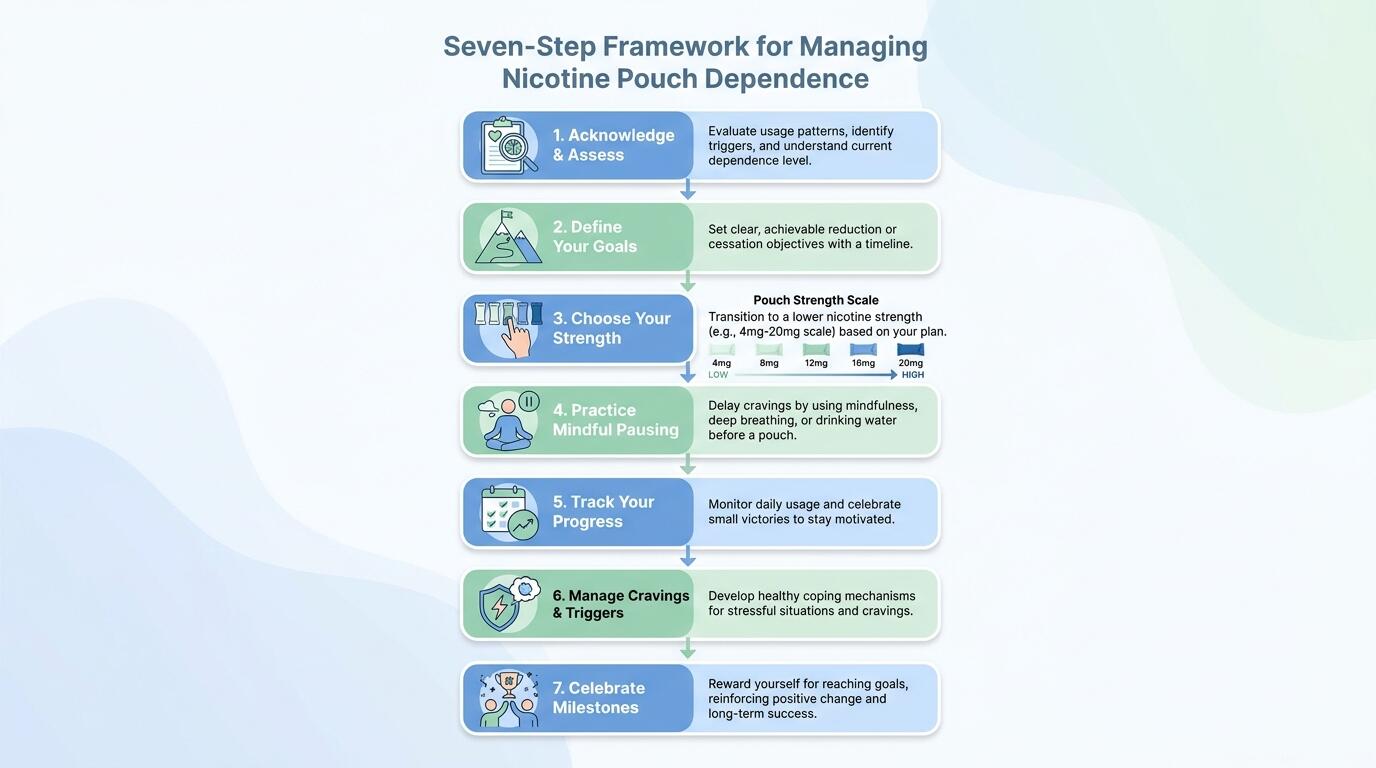
ALT: Step-by-step guide to understanding and managing nicotine pouch dependence for health-conscious adult users seeking tobacco-free alternatives
A Step-by-Step Framework for Thinking About Nicotine Pouch Dependence
This framework is built around the patterns we consistently see among adults navigating their relationship with nicotine — whether they are stepping away from cigarettes, managing stress in demanding professional environments, or simply trying to make a smarter choice about a habit they have no immediate intention of stopping.
Step 1: Understand What Nicotine Dependence Actually Means
Nicotine dependence is a physiological and psychological state in which the body adapts to regular nicotine intake, leading to cravings, irritability, or difficulty concentrating when nicotine is absent. It develops through repeated use and is driven by nicotine's interaction with acetylcholine receptors in the brain, which over time become calibrated to expect nicotine's presence.
This is real, and it is worth taking seriously. At the same time, the word "dependence" carries significant cultural weight that sometimes obscures more than it reveals. Caffeine, for example, produces a recognizable dependence pattern in many daily coffee drinkers — yet most health frameworks treat it as a manageable lifestyle habit. The question is not whether dependence exists, but whether the trade-offs are acceptable given what you are replacing or what you are choosing instead.
Tip: When evaluating your own dependence risk, consider your baseline — not against an abstract ideal of zero nicotine, but against your current or previous product use. For a smoker, switching to nicotine pouches represents a substantial reduction in harm even if nicotine intake continues.
Step 2: Know the Difference Between Dependence and Harm
Nicotine dependence and nicotine-related harm are not the same thing, and conflating them leads to poor decisions. Nicotine itself is associated with elevated heart rate and blood pressure in the short term, and prolonged high-dose use is not without consideration. However, the dominant sources of tobacco-related disease — lung cancer, chronic obstructive pulmonary disease, cardiovascular damage from combustion — are products of burning tobacco, not of nicotine in isolation.
Nicotine pouches, by their nature, sidestep the combustion problem entirely. They are placed in the mouth, deliver nicotine through the gum tissue, and are then discarded. There is no smoke, no tar, no carbon monoxide, and no secondhand exposure for people around you.
For anyone asking whether nicotine pouch dependence is something to worry about from a harm-reduction perspective, the honest answer is: probably less so than the alternative most switchers are coming from, though it still warrants mindful management.
Tip: Seek out products from brands that are transparent about what goes into their pouches. QOLA, for instance, has made a clear public commitment to clean formulation — worth reviewing if ingredient transparency matters to your decision-making.
Step 3: Assess Your Actual Usage Pattern
One of the most useful things you can do is observe your own behavior over a week or two without judgment. How many pouches are you using per day? Are you reaching for one out of habit, boredom, stress, or genuine craving? Do you feel restless or irritable when you go several hours without one? Are you using higher-strength pouches than you actually need?
In our work with users exploring tobacco-free alternatives, a common pattern emerges: people often use more than they consciously realize, and they often use a higher strength than their actual tolerance requires. Both patterns increase dependence potential without necessarily increasing satisfaction.
QOLA's nicotine pouches are available in a range of strengths from 4mg to 20mg, which means there is genuine room to right-size your usage. Understanding the full strength range from 4mg to 20mg can help you identify whether you are using more nicotine than you actually need — a practical first step toward more intentional use.
Tip: Keep a simple daily log for one week. Note the time, the strength used, and what prompted you to use it. Patterns become visible quickly, and visibility is the precondition for any meaningful change.
Step 4: Decide What Your Actual Goal Is
This step is where most people skip ahead too quickly. Before worrying about whether your dependence is a problem, you need to decide what success actually looks like for you. That means being honest about your goals.
Are you using nicotine pouches as a bridge to eventually stopping nicotine altogether? If so, your approach should involve a gradual step-down in strength over time — moving from higher-strength to lower-strength pouches as your tolerance adjusts. Are you using them as a long-term replacement for smoking, with no current intention to quit nicotine? That is also a legitimate adult decision, and in that context, managing dependence means keeping your use stable and controlled rather than escalating.
Are you using them situationally — during travel, in meetings, in environments where smoking is not possible? In that case, your dependence risk is likely lower, and your focus should be on ensuring your use does not drift from situational to habitual without you noticing.
Tip: Write down your goal in a single sentence. "I want to stop smoking and eventually reduce nicotine entirely" is different from "I want a cleaner way to manage nicotine long-term." Both are valid, but they call for different strategies.
Step 5: Choose the Right Strength for Your Intent
Strength selection is probably the single most practical lever available to nicotine pouch users who want to manage dependence thoughtfully. Using a 20mg pouch when your body would be satisfied with an 8mg one is not only unnecessary — it actively builds a higher dependence threshold over time.
A sensible rule is to start at the lowest strength that adequately manages your cravings or replaces your previous habit, then reassess after a few weeks. If you are transitioning from heavy smoking, a higher starting point may be appropriate. If you are a lighter user or someone new to nicotine products, starting lower gives you more room to maneuver.
The 4mg to 20mg range that QOLA offers is precisely the kind of graduated spectrum that makes intentional management possible. It allows you to move incrementally rather than making dramatic jumps that feel unsustainable.
Tip: Avoid the temptation to use a stronger pouch because "it lasts longer" or "kicks in faster." Faster onset at higher doses is exactly the pharmacological profile that builds stronger dependence.
Step 6: Build Intentional Pauses Into Your Routine
One underappreciated strategy for managing nicotine pouch dependence is deliberate, structured reduction — not stopping entirely, but introducing gaps. This might mean choosing one part of the day (morning, for example) where you delay your first pouch by an hour, or designating a few days a week as lower-use days.
The goal is not deprivation. It is ensuring that your use stays chosen rather than compelled. There is a meaningful psychological difference between reaching for a pouch because you enjoy it and reaching for one because you feel you cannot function without it. Intentional pauses help you stay on the right side of that line.
Tip: Pair pauses with something genuinely enjoyable — a walk, a coffee, a few minutes of focused reading. This retrains your brain's association between reward and nicotine, which over time makes the dependence less central to your daily functioning.
Step 7: Know When to Seek Additional Support
If you find that you are unable to reduce usage despite wanting to, that your consumption is escalating rather than stabilizing, or that you feel significant distress when access to pouches is restricted, those are signals worth taking seriously. Nicotine replacement therapies, behavioral support programs, and professional counseling are available resources, and there is no virtue in managing this alone if external support would help.
This is particularly relevant for anyone who was a heavy smoker before switching. The underlying nicotine dependence established through years of smoking does not simply reset when the delivery mechanism changes. It evolves, but it takes time, and sometimes professional guidance accelerates the process meaningfully.
Tip: Many healthcare providers now have specific experience with tobacco-free nicotine product use. A conversation with your GP or a cessation counselor does not commit you to any particular path — it simply gives you better information.
Common Mistakes and How to Fix Them
| Symptom | Likely Cause | How to Fix |
|---|---|---|
| Using more pouches than intended each day | Using too low a strength, so cravings are not fully satisfied | Step up one strength level and reassess — fewer pouches at an adequate strength often leads to lower total nicotine intake |
| Feeling strong cravings within minutes of removing a pouch | Dependence threshold has risen; usage is too frequent | Extend the time between pouches deliberately; introduce structured gaps during low-stress periods |
| Difficulty going through a meeting or flight without nicotine | Behavioral dependence layered onto physical dependence | Work on situational unbundling — identify specific triggers and practice tolerating them briefly before using |
| Assuming switching to pouches means dependence is no longer an issue | Misunderstanding the difference between harm reduction and dependence elimination | Revisit goals; harm reduction is real and valuable, but nicotine dependence still benefits from active management |
| Escalating to higher strengths without reassessing | Tolerance increase driven by frequency, not need | Audit your usage pattern; consider a strength step-down during a lower-stress period |
| Using pouches at night or upon waking | Dependence is driving use rather than preference | Establish a "no pouch" window in the morning or evening; break the automatic behavior loop |
Pro Tips for Getting More From Your Approach
Match strength to context, not habit. A common and costly mistake is using the same strength in every situation. A high-stress deadline moment may warrant a moderate-strength pouch; a relaxed Sunday morning may call for something much lighter, or nothing at all. Variable use by context keeps your average daily intake lower without requiring you to feel deprived.
Treat flavor as a tool, not just a pleasure. A distinct, interesting flavor — mint, citrus, floral — can make a lower-strength pouch feel more satisfying by engaging your senses more fully. This is not trivial: sensory engagement is a real component of satisfaction, and leveraging it means you get more value from less nicotine.
Think in weekly patterns, not daily ones. Day-to-day variation in usage is normal and not necessarily cause for concern. What matters more is whether your weekly average is stable, rising, or falling. A rising trend over several consecutive weeks is a clearer signal to investigate than a single high-use day.
Do not use dependence concern as a reason to avoid a genuinely better alternative. A common misconception we encounter is that because nicotine pouches can produce dependence, they are not meaningfully different from cigarettes. This is not supported by the evidence. Dependence on a relatively clean delivery mechanism is a different proposition from dependence on a combusted product that delivers thousands of toxic compounds alongside nicotine. For adults who smoke and cannot or do not wish to stop nicotine use, switching to a tobacco-free format represents a real and meaningful improvement.
Invest in understanding what you are consuming. Ingredient transparency is one of the most practical differentiators between nicotine pouch brands. Choosing a product with a clean formulation — free of unnecessary additives and clearly labeled — means you can focus on managing your nicotine intake rather than worrying about compounding variables.
People Also Ask
Q1: How quickly does nicotine pouch dependence develop?
Nicotine dependence can develop relatively quickly with regular use — studies and clinical observations suggest that consistent daily use over a period of weeks can begin to establish physiological reliance. The rate depends on individual factors including genetics, previous nicotine history, and the strength of the product used. Higher-strength pouches used frequently create dependence more rapidly than lower-strength products used occasionally. Starting at the lowest effective strength and using pouches situationally rather than compulsively is the most practical way to slow the development of dependence, according to public health guidance from organizations such as the U.S. Food and Drug Administration.
Q2: Are nicotine pouches less addictive than cigarettes?
Nicotine pouches deliver the same addictive substance as cigarettes — nicotine — so dependence is possible with both. However, several factors may make pouch-based dependence somewhat different in character: nicotine absorption through the oral mucosa is slower than through the lungs, which may produce a less intense and less immediate reward signal. Cigarette smoking also involves behavioral rituals and social cues that reinforce addiction beyond the pharmacological effect. That said, "less addictive" is not the same as "non-addictive," and adults should approach nicotine pouches with the same intentionality they would bring to any nicotine product.
Q3: How long does it take to reduce nicotine pouch dependence if you want to stop?
The timeline for reducing nicotine pouch dependence varies considerably by individual, usage history, and chosen approach. A gradual step-down in strength over several weeks to months is generally considered more sustainable than abrupt cessation. Someone who has used moderate-strength pouches for a relatively short period may find the process straightforward over a matter of weeks. Someone with a long history of heavy nicotine use — particularly if they were previously a heavy smoker — may need a longer, more supported reduction journey. Behavioral support alongside pharmacological step-down tends to produce better outcomes than either approach alone, based on established cessation research.
Summary
Nicotine pouch dependence is real, worth understanding, and entirely manageable with the right approach. It is not a reason to avoid tobacco-free nicotine products if they represent a genuine improvement over what you are currently using — but it does deserve honest, ongoing attention.
Key Takeaways:
- Nicotine dependence occurs with any regular nicotine product; pouches are not exempt, but their harm profile differs substantially from combusted tobacco.
- The strength you choose and how frequently you use pouches are the two most controllable variables in managing dependence.
- Defining your goal — step-down to zero, long-term harm reduction, or situational use — determines what good management actually looks like for you.
- Deliberate pauses and strength step-downs are practical tools that keep use chosen rather than compelled.
- If dependence is escalating rather than stabilizing, professional support is available and worth using.
- Ingredient transparency matters: a clean, well-formulated product removes compounding variables from your assessment.
The smartest next step is to look honestly at your current usage pattern, clarify your personal goal, and choose products that give you the flexibility to move in the right direction at a pace that works for you.
Ready to take control of your nicotine experience with a product built for modern, mindful living? Explore the full range of tobacco-free nicotine pouches — available in multiple flavors and strengths from 4mg to 20mg — at the QOLA website, and find the starting point that fits your life.
References
- qola.com. "QOLA Nicotine Pouches UK|No Smoking, No Vaping - Just qola".
https://qola.com/uk - U.S. Food and Drug Administration. "Nicotine and Addiction: What Users Should Know".
https://www.fda.gov - World Health Organization. "Tobacco and Nicotine: Health Guidance and Resources".
https://www.who.int
Note: Standards and guidance may be updated; please check the latest official documents or consult professional advisors.

Comments
There are no comments yet.