
Why Proper Storage Makes or Breaks Your Nicotine Pouch Experience
How you store your nicotine pouches directly determines how they taste, how effectively they deliver nicotine, and how long they stay worth using. The answer is straightforward: keep them sealed, cool, and away from moisture — and you'll preserve every can exactly as it was intended.
This guide is for anyone who uses tobacco-free nicotine pouches regularly and wants to get consistent, high-quality results from every can they open. Whether you're newer to the format and still learning the basics, or you've been through enough cans to notice that some feel noticeably better than others, this practical walkthrough covers exactly what's happening inside that can and what you can do about it.
Before You Start: What You Need to Know Before Opening Your Next Can
Good nicotine pouch storage isn't complicated, but it does require understanding what you're actually protecting. A nicotine pouch is a small, pre-portioned pouch containing tobacco-free nicotine, plant-based fibers, flavorings, and moisture-regulating ingredients. The pouch is engineered to release nicotine and flavor at a controlled rate when placed between the gum and upper lip — but that engineering relies on the contents remaining stable until use.
The three main threats to that stability are heat, moisture, and air exposure. Heat accelerates the breakdown of flavor compounds and can cause nicotine degradation. Excess moisture causes the pouch material to swell and the contents to clump, which disrupts the controlled-release effect. Air exposure — particularly in a can that's been opened and left unsealed — allows flavors to oxidize and fade.
Before working through the storage steps below, it's worth taking a moment to assess your current habits against this quick checklist.
Checklist before starting:
- Confirm whether your pouches are sealed (unopened) or in-use (partially consumed from an open can)
- Identify where you currently store your cans — a bag pocket, a desk drawer, a car compartment, a bathroom shelf
- Note whether you've experienced any of these warning signs: dried-out pouches, faded flavor, stiff or brittle pouch material, or pouches that feel wetter than usual when you open the can
- Have a dry, room-temperature location in mind where you could consistently keep your supply
- Consider whether you carry a daily-use can with you or pull from a larger stored supply
This is a low-effort process once it becomes habit. The investment is a few minutes of reorganization now for noticeably better experiences every time you reach for a pouch.
Step-by-Step: How to Store Nicotine Pouches for Maximum Freshness
Step 1: Keep Sealed Cans at a Stable, Moderate Temperature
Nicotine pouches are most stable when stored at a consistent, moderate room temperature. Fluctuating temperatures — like those in a car's glove compartment or near a radiator — are especially damaging because they cause the contents to expand and contract, stressing the pouch material and potentially breaking the seal of the container.
A kitchen cupboard away from the oven, a desk drawer, or a bedroom shelf all work well. The goal is a space that doesn't experience dramatic temperature swings throughout the day. Avoid windowsills, car consoles, and anywhere that sits in direct sunlight for extended periods.
Tip: A consistent temperature is more important than a cool one. A stable 20°C is better for your pouches than a spot that swings between cold mornings and warm afternoons.
Step 2: Protect Your Supply from Humidity and Moisture
Moisture is arguably the biggest practical threat to nicotine pouch quality. Pouches are engineered with a carefully calibrated moisture content — too much additional humidity causes them to become soggy and over-saturated, while excessively dry conditions cause them to become brittle and underpowered.
Bathrooms, kitchen countertops near the sink, and humid climates present a real risk. Store your cans somewhere with low ambient humidity — a drawer, a cabinet, or even a small sealed container if you live somewhere particularly damp. If you're storing a larger supply, a resealable container or zip bag adds an extra layer of protection against ambient moisture.
Tip: If you live in a consistently humid environment, consider storing your main supply inside a sealable bag with a small food-safe silica gel packet. This is a simple and inexpensive solution that makes a material difference.
Step 3: Avoid Direct Light Exposure
UV light degrades both nicotine and the organic compounds responsible for flavor. This is especially relevant for anyone who stores cans on a desk near a window or in a transparent container on a sunny shelf.
The original can itself provides reasonable protection, but over extended storage periods, light exposure compounds with temperature and humidity to accelerate degradation. Store your pouches somewhere dark when not in immediate use. A drawer or cupboard is ideal; a glass jar on a sunny windowsill is not.
Tip: Even brief, repeated exposure over days adds up. It's not about one afternoon in the sun — it's about where the can lives between uses.
Step 4: Always Reseal the Can Immediately After Use
The most common and easily preventable cause of quality degradation is leaving an open can unsealed. Every QOLA can is designed with a resealable lid — that feature exists for a reason. Each time the can sits open, moisture escapes, flavors oxidize, and the remaining pouches dry out.
Make resealing a reflex: as soon as you've taken a pouch, close the lid. This single habit has the single largest impact on how consistent your experience is across the life of a can.
Tip: If you use pouches throughout a busy day and find yourself opening and closing the can repeatedly, keep the can in a pocket rather than leaving it open on a desk or table. Body temperature is fine for short-term carry; leaving an open can in moving air is what causes problems.
Step 5: Store Long-Term Supply Correctly Before Opening
If you buy in bulk or receive a larger order, the storage rules are slightly different for cans you haven't opened yet. Sealed cans benefit from cooler storage — a consistent spot in a refrigerator (not the freezer) works well for maintaining freshness over an extended period, particularly for flavor-forward varieties where the aromatic compounds are most delicate.
If refrigerating, allow the can to return to room temperature before opening. Condensation forming on a cold can when it's brought into a warm room can introduce surface moisture, and opening it immediately risks that moisture entering the pouch contents. Give it fifteen to twenty minutes at room temperature first.
Tip: Don't freeze nicotine pouches. Freezing can damage the pouch material and disrupt the moisture balance in ways that are difficult to recover from once the pouch thaws.
Step 6: Manage Your Stock with First-In, First-Out Rotation
Nicotine pouches have a shelf life, and while they don't expire in a way that makes them unsafe, their quality — particularly flavor intensity and pouch texture — does decline over time. If you maintain a stockpile, use the oldest cans first.
This is straightforward if you organize your supply so that newer arrivals go behind existing stock. It's a small habit, but it means you're never accidentally reaching for a can that's been sitting at the back of a drawer for months while fresher cans pile up in front.
Tip: Check the best-before date on each can when it arrives. It's printed on most packaging and gives you a useful planning window for how long you can reasonably hold stock.
Step 7: Carry Sensibly — Protect Your Daily-Use Can
The can you're actively using throughout the day is exposed to more variable conditions than your stored supply: body heat, the pressure of a tight pocket, the occasional forgotten overnight in a bag. None of these will ruin your pouches outright, but cumulative rough handling does affect quality over time.
A slim, hard-sided carry case offers protection if you're concerned about compression. More practically, keeping your active can in a consistent spot — an inside jacket pocket or a dedicated compartment in your bag — reduces the chances of it getting crushed, overheated, or left somewhere inconvenient.
Tip: Keep your daily-use can and your stored supply separate. Don't pull one pouch from an older can and then leave that partially used can lying around — work through each can before opening another.
Common Mistakes and How to Fix Them
| Symptom | Likely Cause | How to Fix |
|---|---|---|
| Pouches feel dry and brittle when you take them out | Can left open or stored in a low-humidity, arid environment | Reseal cans immediately after use; store in a location with stable ambient humidity |
| Flavor is noticeably weaker than when the can was first opened | Air exposure and oxidation; possible light damage | Form a resealing habit; move storage away from windows and open surfaces |
| Pouches feel soggy or over-saturated | Stored in a high-humidity area or exposed to moisture | Move storage to a dry cabinet; use a small silica gel packet for bulk supply |
| Pouch material feels stiff or the pouch has changed shape | Temperature fluctuations during storage or transport | Find a temperature-stable storage spot; avoid cars and windowsills |
| Nicotine release feels inconsistent can-to-can | Older stock mixed with new; poor stock rotation | Implement first-in, first-out rotation; check best-before dates on arrival |
| Condensation inside the can when opened | Can taken from cold storage to warm room too quickly | Allow refrigerated cans to reach room temperature before opening |

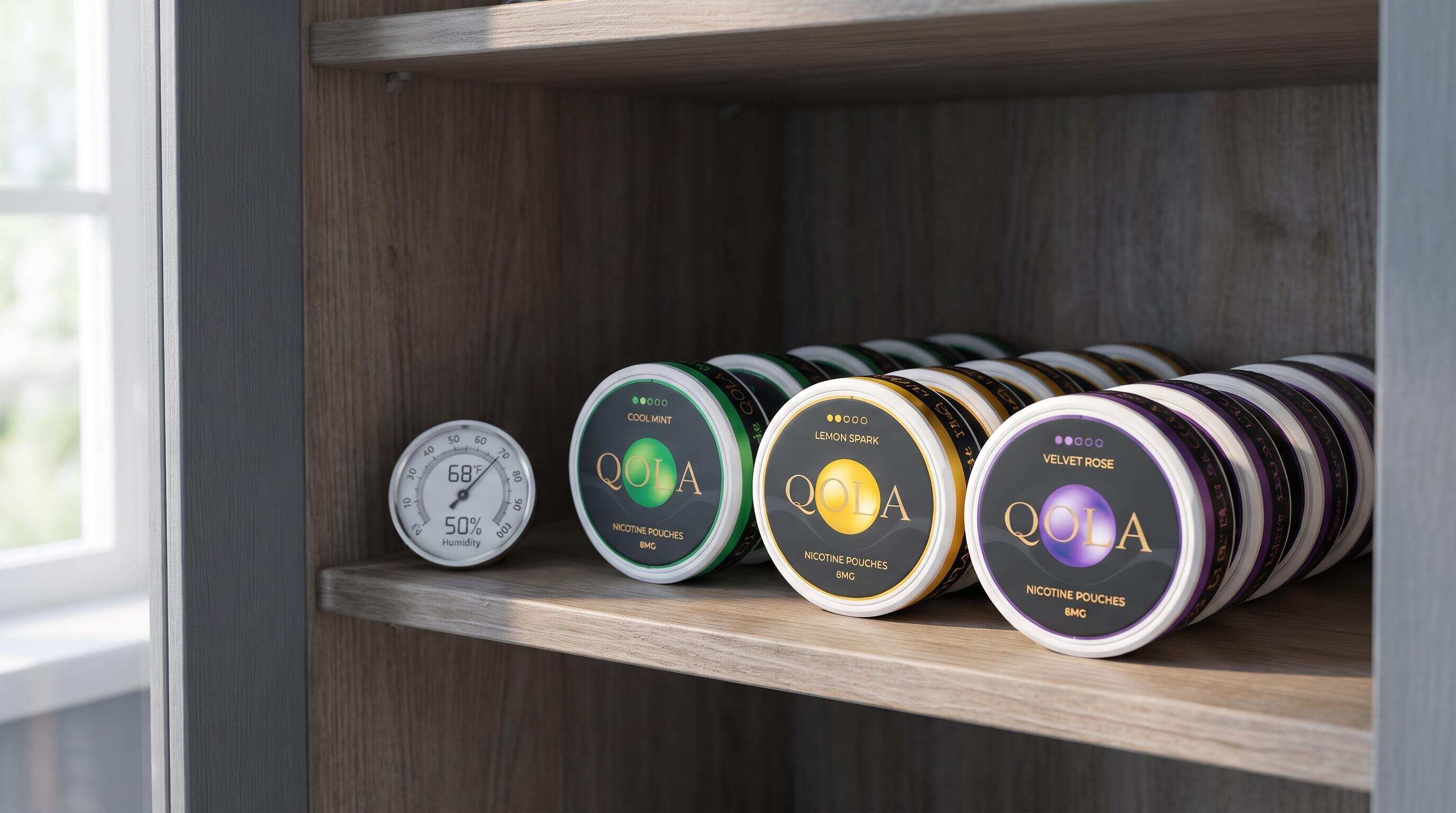
ALT: Nicotine pouches arranged in a cool, dry drawer away from sunlight demonstrating optimal storage conditions for freshness and quality
Pro Tips for Getting Even More From Your Storage Routine
Treat your most aromatic flavors with extra care. Fruit, floral, and complex blended flavors rely on volatile aromatic compounds that degrade faster than straightforward mint profiles. If you're working through a range — such as QOLA's mint, fruit, and floral varieties — prioritize consuming your more aromatic options first, and store them in the most stable conditions you have available.
Understand that refrigeration is a tool, not a requirement. Many users assume they must refrigerate their pouches, or conversely, that refrigerating them is unnecessary. The truth is nuanced: refrigeration genuinely extends freshness for sealed, unopened stock held over a longer period, but it adds complexity (the room-temperature transition step) and isn't necessary for cans you'll work through within a few weeks.
Be skeptical of "hack" storage solutions. You'll occasionally see suggestions online for adding moisture to dried-out pouches — wetting the inside of a can lid, placing a small damp paper insert, and similar workarounds. These can introduce contamination and unpredictable moisture levels that cause more problems than they solve. The right fix for dried-out pouches is better prevention, not post-hoc remediation.
Common misconception: a tighter pack seal means better storage. Some users assume that pressing the lid down harder than the designed closure point will keep the can fresher. This can actually damage the lid's sealing mechanism and make the closure less reliable over time. Use the designed closure — it's engineered to do the job correctly.
Consider your strength level when storing. Higher-concentration pouches — such as those toward the stronger end of a range like QOLA's 4mg to 20mg spectrum — may be more sensitive to degradation simply because you're relying on precise release. For high-strength formats, consistent storage is especially worth maintaining.
Questions & Answers
Q1: How long do nicotine pouches stay fresh once a can is opened?
An opened can of nicotine pouches generally maintains good quality for several days to a couple of weeks when resealed properly and stored in stable conditions. Flavor-forward varieties tend to show decline faster than neutral or mint profiles. The key variable is how consistently you reseal the can after each use — a can that's been left open repeatedly will degrade significantly faster than one that's sealed between every use.
Q2: Is it safe to store nicotine pouches in the refrigerator?
Refrigerating sealed, unopened cans of nicotine pouches is a genuinely effective way to extend their freshness over longer storage periods. The main precaution is allowing the can to reach room temperature before opening it, which prevents condensation from introducing excess moisture to the contents. Freezing is not recommended — it can damage the pouch material and disrupt moisture balance in ways that affect performance after thawing.
Q3: Does storage location affect nicotine strength or just flavor?
Poor storage primarily affects flavor intensity and pouch texture, but it can also impact how effectively nicotine is released. Nicotine itself can degrade when exposed to heat, light, and oxygen over time. If pouches have been stored in unstable conditions for an extended period, you may notice both a weaker flavor and a less consistent experience. This is why first-in, first-out rotation and proper sealing matter even beyond just preserving taste.
The Bottom Line
Proper nicotine pouch storage is a small discipline with a meaningful return. The core principles are simple: seal every can after use, keep your supply away from heat, light, and moisture, allow refrigerated stock to reach room temperature before opening, and rotate through older cans before newer ones.
Key Takeaways:
- Reseal your can immediately after every use — this single habit has the greatest impact on freshness
- Store pouches in a cool, stable-temperature location away from sunlight and humidity
- Refrigeration is useful for long-term sealed stock, but requires a room-temperature transition step before opening
- Never freeze nicotine pouches — it damages pouch structure and moisture balance
- Rotate stock first-in, first-out and check best-before dates when building a supply
If you're building good habits around your nicotine pouch use from the ground up, it's worth pairing smart storage with a broader understanding of how nicotine pouches work and what to look for in a quality product. The experience you get out of your pouches is shaped by both the quality that goes in and how well you protect it afterward.
Ready to experience nicotine on your own terms? Visit QOLA's full lineup to explore tobacco-free nicotine pouches across a modern range of flavors and strengths — no smoke, no vapor, no odor, just clean and discreet satisfaction.
References
- qola.com. "QOLA Nicotine Pouches UK|No Smoking, No Vaping - Just qola".
https://qola.com/uk - U.S. Food and Drug Administration. "Nicotine and Tobacco Products".
https://www.fda.gov - World Health Organization. "Tobacco and Related Products".
https://www.who.int
Note: Standards may be updated; please check the latest official documents or consult professional advisors.
Comments
There are no comments yet.