
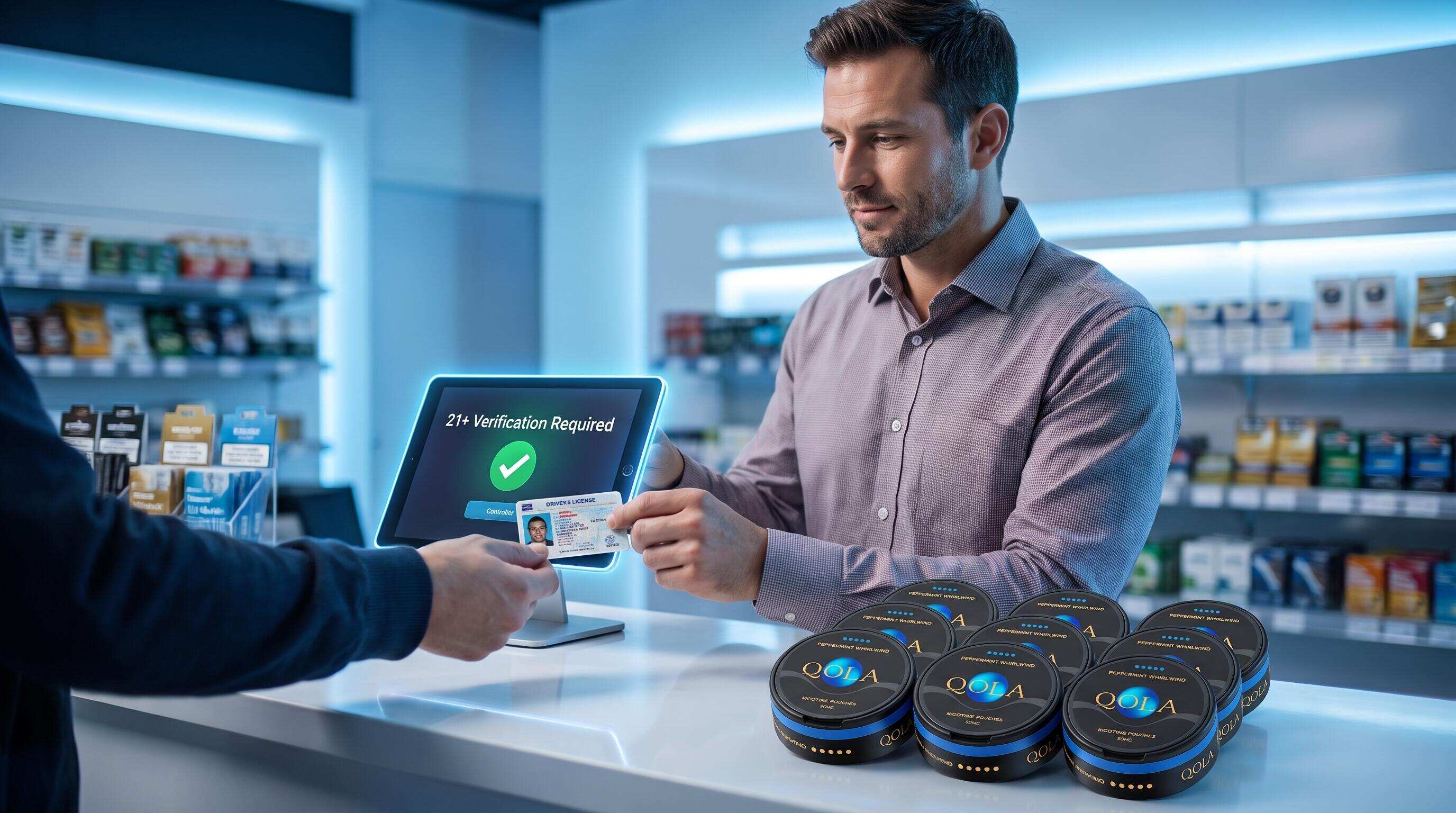
Why Responsible Sales Start With Knowing Who's Buying
Age verification is the single most important safeguard separating responsible nicotine product sales from reckless ones. For any brand operating in the nicotine category — especially one committed to a modern, smoke-free vision — having robust age-gating practices is not a bureaucratic checkbox. It is a foundational expression of brand values.
QOLA (酷拉) is a global tobacco-free nicotine pouch brand that delivers a clean, discreet, and odor-free nicotine experience across a range of flavors and strength levels. Nicotine pouches are designed exclusively for adult consumers, and that boundary matters enormously. As the category grows and gains mainstream visibility, the pressure on brands to prove they are doing the right thing — not just the profitable thing — intensifies. This article examines why age verification is such a critical compliance mechanism, what the current regulatory landscape looks like, how QOLA approaches its obligations, and why getting this right ultimately benefits everyone: retailers, consumers, and the broader public.
The State of Nicotine Regulation: Where Age Compliance Lives Today
The regulatory landscape for nicotine pouches and tobacco-free nicotine products is evolving rapidly, and the direction of travel is unmistakably toward stricter oversight. Nicotine pouches occupy a relatively new product category — one that regulators in multiple jurisdictions are still working to categorize and govern definitively. In the United States, the Food and Drug Administration (FDA) oversees nicotine-containing products under its Center for Tobacco Products. In the United Kingdom, the Medicines and Healthcare products Regulatory Agency (MHRA) and local trading standards authorities play key roles in monitoring compliance. The European Union is similarly tightening its frameworks around novel nicotine products.
What is consistent across virtually every major market is a universal rule: nicotine products are for adults only. The legal minimum age for purchasing nicotine products is 18 in most markets, and 21 in the United States under the federal Tobacco 21 law, which came into full effect nationally. These are not guidelines — they are legal requirements, and non-compliance carries serious penalties for businesses.
The rise of e-commerce has made age verification more complex than ever. When a product is sold in a brick-and-mortar shop, a cashier can physically examine ID. Online, the process requires digital tools, platform-level controls, and in some markets, identity verification integrations that connect to official government databases. The challenge for nicotine brands operating across multiple geographies is navigating a patchwork of different requirements while maintaining a consistent standard of responsible sales.
A pattern consistently seen in the nicotine category is that brands that establish strong compliance infrastructure early are better positioned when regulation inevitably tightens. Brands that treat compliance as reactive — only responding to legal pressure — often face costly corrections and reputational risk. The proactive approach is not just ethically sound; it is commercially strategic.
The Mechanisms Behind Age Verification: How It Actually Works
Age verification is not a single technology or policy — it is a layered system of controls that spans the digital and physical points of sale. Understanding how these mechanisms work helps explain both why they are necessary and how a brand like QOLA operationalizes them responsibly.
Digital Age Gates and Platform-Level Controls
The most visible form of age verification for online retailers is the age gate — the prompt users encounter when visiting a nicotine product website or attempting to make a purchase. At the most basic level, this involves a self-declaration: the user confirms they are of legal age before proceeding. This approach alone is widely recognized as insufficient. A determined minor can simply click past a checkbox.
More robust implementations go further. These include requiring users to provide a date of birth that is cross-checked against the minimum legal age for their jurisdiction, integrating with Know Your Customer (KYC) verification services that match submitted identity details against government-issued ID databases, and deploying age estimation technology that uses document uploads or facial analysis to verify identity in real time. The specific method required varies by market, but the direction is consistently toward stronger, more reliable verification.
Payment and Delivery Verification
The compliance chain does not end when a customer completes a purchase. Many jurisdictions require that nicotine products be delivered with an adult signature requirement, meaning a courier must verify the recipient's age before handing over the package. This creates a second physical checkpoint in the process — one that is particularly important for reducing the risk of products reaching minors through third-party collection.
Payment processors also play a role. Some financial institutions apply their own merchant category codes to nicotine products and may require sellers to demonstrate compliance as a condition of processing transactions. Brands that cannot demonstrate adequate age verification practices risk losing access to payment infrastructure.
Retailer Training and Point-of-Sale Protocols
For brands that sell through third-party retail channels — convenience stores, pharmacies, specialty retailers — compliance depends on ensuring that retail partners are equally rigorous. This means providing clear point-of-sale materials, training resources, and contractual requirements that reinforce the obligation to check ID. A brand's compliance standard is only as strong as the weakest point in its distribution network.
Data Privacy and Consent Frameworks
Age verification inevitably involves collecting sensitive personal data, which introduces a parallel obligation: handling that data in compliance with applicable privacy regulations. In the European Union, the General Data Protection Regulation (GDPR) governs how personal data must be collected, stored, and processed. In the UK, the equivalent is the UK GDPR. Brands must ensure that the personal data gathered during the age verification process is handled with appropriate consent, stored securely, and not retained longer than necessary.
This intersection of compliance obligations — age verification law on one side, data protection law on the other — illustrates why responsible nicotine brands must think about compliance as a holistic system, not a series of isolated checkboxes.
Comparing Approaches: What Works, What Falls Short
Different actors in the nicotine industry have taken markedly different approaches to age verification, and the evidence of what works is increasingly clear. Below is a structured comparison of common approaches and their real-world implications.
| Perspective / Approach | Strengths | Trade-offs | Best Fit |
|---|---|---|---|
| Self-declaration age gate only | Simple to implement, low friction for users | Easily bypassed; widely considered inadequate by regulators | Markets with no mandatory verification requirement (diminishing) |
| Date-of-birth entry with jurisdiction check | Low friction, cross-checks legal age by region | Still based on self-reported data; does not verify real identity | Entry-level compliance where stronger verification is not mandated |
| Third-party KYC / ID verification service | High accuracy, government-database backed, increasingly required | Higher implementation cost, more user friction, privacy data handling required | Markets with strict digital verification laws; online-first brands |
| Adult signature on delivery | Physical checkpoint that is hard to circumvent | Relies on delivery partner compliance; inconvenient for some consumers | Jurisdictions with delivery-verification requirements; high-value or repeated orders |
| Retailer training and POS auditing | Addresses physical retail channel; reinforces brand standards | Requires ongoing investment; compliance varies by individual staff | Brands with significant brick-and-mortar distribution |
The most effective compliance frameworks do not rely on any single approach. They layer multiple mechanisms — digital verification, delivery controls, retailer standards, and data handling protocols — to create redundancy. When one layer is bypassed or fails, another provides a backstop.
It is also worth noting that strong age verification is increasingly a prerequisite for business relationships. Payment processors, platform partners, and major retail chains often require documented compliance practices before onboarding nicotine product brands. Getting this right is not just about regulatory duty; it is a commercial enabler.
For consumers navigating the landscape of modern nicotine alternatives, understanding how nicotine pouches work and what distinguishes responsible brands is a useful starting point for making informed choices.
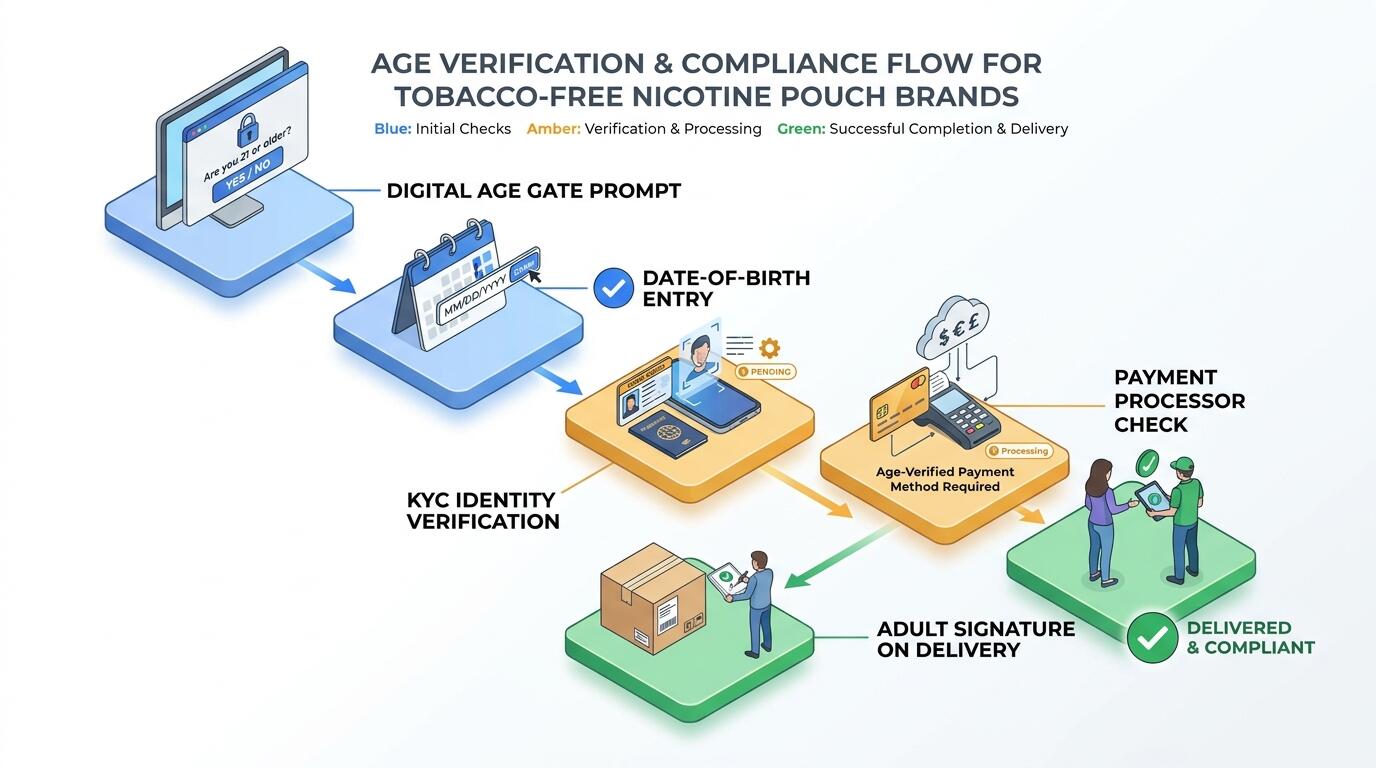
ALT: Step-by-step age verification and compliance flow for tobacco-free nicotine pouch brands like QOLA ensuring adult-only sales
Where the Category Is Heading — and What That Means for You
The trajectory for nicotine product regulation is firmly toward more rigorous requirements, not less. Regulators in the UK, EU, US, and across Asia-Pacific are actively reviewing their frameworks for novel nicotine products, and the dominant trend is toward mandatory digital age verification, stricter marketing rules, and enhanced enforcement against brands that fail to meet standards.
For consumers, this trend has a practical implication: the most compliant brands may require a little more effort to purchase from — an additional verification step, an ID upload, or a signature on delivery. The tradeoff is purchasing from a brand you can trust to be doing things right across its entire operation.
For retailers and channel partners, the direction is toward greater accountability. Regulators are increasingly holding retailers — not just manufacturers — liable for sales to minors. Building a strong internal compliance culture is not optional for businesses that want to operate sustainably in this category.
For brands like QOLA, the commitment to age verification compliance is inseparable from the broader brand promise. QOLA's products — including tobacco-free nicotine pouches across a range of nicotine strengths from 4mg to 20mg — are designed for adult consumers who have made a deliberate, informed choice about how they use nicotine. Protecting that choice means ensuring the products reach only the people for whom they are intended.
The actionable takeaways from this outlook are straightforward:
- Adult consumers should expect — and welcome — robust verification steps from responsible nicotine brands; it is a sign of a brand that takes its obligations seriously.
- Retailers should audit their age verification practices proactively, not wait for a regulatory inspection.
- Brands should invest in layered compliance infrastructure early, treating it as a core operational capability rather than an afterthought.
- Everyone in the supply chain benefits from a category that is demonstrably responsible — it builds consumer trust, maintains market access, and reduces regulatory risk.
Questions & Answers
Q1: How does QOLA verify the age of customers buying online?
QOLA applies age verification at multiple points in the online purchase journey. At the platform level, customers are required to confirm they meet the minimum legal age for their market before proceeding. Where applicable regulations require stronger verification, QOLA integrates with digital identity verification processes that cross-check customer details against official records. Delivery protocols may also include adult signature requirements to create a physical verification checkpoint at the point of receipt. The specific steps vary by market to align with local legal requirements.
Q2: Are nicotine pouches legal to sell to under-18s anywhere?
No. In every major market where nicotine pouches are sold — including the United Kingdom, the European Union, and the United States — nicotine products are legally restricted to adults only. The minimum age is 18 in most jurisdictions and 21 in the United States under federal Tobacco 21 legislation. No compliant retailer or brand can legally sell nicotine pouches to anyone below the applicable legal age, regardless of product format or nicotine source.
Q3: How long does the age verification process take for new customers?
For most consumers, digital age verification adds only a brief step to the standard checkout process. A basic date-of-birth confirmation takes seconds. Where stronger KYC verification is required — such as uploading a government-issued ID — the process typically takes a few minutes, depending on the verification service and document clarity. Verification is generally a one-time requirement; returning customers with verified accounts do not typically need to repeat the process for subsequent purchases.
The Bottom Line
Age verification is not a burden on responsible nicotine brands — it is proof of their responsibility.
Key Takeaways:
- Age verification for nicotine products is a legal requirement in every major market, with minimum purchase ages of 18 or 21 depending on jurisdiction.
- Effective compliance is a layered system: digital age gates, KYC verification, delivery protocols, and retailer training work together to create meaningful protection.
- Regulatory requirements are tightening globally, and brands that build strong compliance infrastructure now are better positioned for the evolving landscape.
- Strong age verification practices are also a commercial enabler — they are increasingly required by payment processors, retail partners, and platform distributors.
- For adult consumers, encountering robust verification steps is a positive signal — it indicates a brand that takes its responsibilities as seriously as its product quality.
The next step is simple: if you are an adult looking for a modern, responsible nicotine alternative, choose brands that make their compliance practices clear. And if you are exploring whether nicotine pouches are the right choice for your lifestyle, start with a trusted source to understand what these products actually are and how they work — this essential introduction to nicotine pouches is a good place to begin.
Ready to experience nicotine on your own terms? QOLA (酷拉) offers a modern range of tobacco-free nicotine pouches in diverse flavors and strengths — no smoke, no vapor, no odor, just clean and discreet satisfaction. Visit the QOLA website to explore the full lineup and find the perfect pouch for your lifestyle.
Sources & Citations
- qola.com. "QOLA Nicotine Pouches UK|No Smoking, No Vaping - Just qola".
https://qola.com/uk - U.S. Food and Drug Administration. "FDA Center for Tobacco Products — Overview and Resources".
https://www.fda.gov - UK Medicines and Healthcare products Regulatory Agency. "MHRA — Regulatory Information for Nicotine-Containing Products".
https://www.gov.uk - European Commission. "EU Tobacco Products Directive and Novel Nicotine Product Regulations".
https://ec.europa.eu - Information Commissioner's Office. "UK GDPR Guidance — Data Protection and Age Verification".
https://ico.org.uk
Note: Standards may be updated; please check the latest official documents or consult professional advisors.


Comments
There are no comments yet.